How to Specify an Oxygen Barrier Pouch | Logos Sendiri
November 24, 2026
custom pouch price malaysia: 3 Cost Levers | Logos Sendiri
November 24, 2026
A buyer places two empty samples on the table. One is a flat, tightly sealed retort pack built to survive a heat process; the other is a boxy stand up pouch that sits proudly on a shelf. On looks alone the choice seems easy. It stops being easy the moment you ask what the product must endure, how it will be filled, and what the customer does with the pack at home. This guide treats retort pouch vs stand up pouch as a five-row decision matrix so you can shortlist the format before you request a quote.
You probably already know that the two formats are not interchangeable, even if a supplier suggests otherwise. What is harder to find is a neutral way to compare them without a sales pitch getting in the way. So here is the promise: five rows, each asking a different question, with a shortlist method at the end. No format is declared the winner, because the right answer depends on your product, your process and your order quantity.
Key takeaways – Retort and stand up formats are decided by heat process first: one must withstand in-pack cooking, the other usually does not. – Barrier and storage behaviour differ because the structures differ; compare them against your product, not against a generic rating. – Fill format, closure and retail handling often settle the choice once the technical rows are tied. – Tooling and order quantity move the unit cost more than the format name alone — confirm both with the supplier. – Score the five rows on your own brief, then prove the shortlisted format with a line trial.
What the retort pouch vs stand up pouch decision really changes
The retort pouch vs stand up pouch question is often asked as if it were about appearance. It is really about process. A retort pack is filled and then heated in its sealed state to make the contents shelf-stable without refrigeration; the film must tolerate that heat while staying intact and keeping its seal. A stand up pouch is usually filled with a product that has already been cooked or does not need in-pack sterilisation, so its structure is designed around presentation, resealing and line speed instead.
That difference cascades. It changes the layer stack, the seal chemistry, the closure options, the way the pack behaves on a filling line, and the sort of artwork finish that survives handling. When you compare retort pouch vs stand up pouch on looks alone, you are comparing the last ten percent of the decision and ignoring the ninety percent that determines whether the pack works.
A quick way to feel the difference is to imagine the same recipe in both packs. Cook a sauce, seal it in a retort pouch and heat the sealed pack, and the film is doing one job. Put the same sauce in a stand up pouch with a spout, and the film is doing another: it must survive filling, stand on a shelf and let the customer pour without making a mess. The recipe did not change; the demands on the pack did. That is why the comparison is about process before appearance.

The retort packs in the photograph — fish, rice, sardines — show the format doing its characteristic job: hermetically sealed, flat, and built for a cooked meal that will sit on a shelf until opened. A stand up pouch in a snack aisle solves a different problem. Keep that contrast in mind as we work through the five rows.
Matrix row 1: heat process and what the structure must survive
Start with the harshest thing that will happen to the pack. If your product is cooked inside the sealed pouch, the structure must be built for retort conditions: heat, pressure and time. That normally means a robust multi-layer laminate with a sealant that stays reliable after processing, rather than a film chosen mainly for gloss or a clear window.
If your product is filled hot, cold or ambient without in-pack cooking, the heat demanded of the pack is far gentler. The stand up pouch can then use a structure tuned for filling temperature and retail handling instead of sterilisation. This row is the cleanest split in the whole comparison: where in-pack heat is required, the retort format is doing a job the standard stand up pouch was not built for.
Ask the supplier to describe the process the film is intended to withstand and how the seal is verified afterwards. General background on heat-processed flexible packs is available from Packaging World, and our own page on a retort pouch with zipper shows how closure choices are handled when resealing is wanted on a retort-format pack.
Two follow-up questions save time later. First, ask whether the quoted structure has been used for a product with a similar acid, salt or fat profile, because the contents can interact with the film during heating. Second, ask how the seal is checked after processing and what happens if a batch fails that check. A supplier who can answer both is describing a process they know, rather than a catalogue option they hope will work.
Matrix row 2: barrier, shelf behaviour and storage
Once heat is settled, compare what each format keeps out and how it behaves in storage. Both formats can be built with high-barrier layers, but the reason for those layers differs. A retort pack is often engineered for long ambient storage after cooking, with the barrier working alongside the heat process. A stand up pouch may be engineered for aroma, moisture or oxygen control depending on whether it holds coffee, snacks, pet food or a liquid.

Do not read a barrier rating as a storage verdict. Storage temperature, humidity, product chemistry and the quality of the seal all change the outcome, so any retort pouch vs stand up pouch comparison on barrier alone is incomplete. Decide your storage conditions first, then ask which structure is proposed for those conditions and how it will be confirmed. The Food Packaging Forum publishes approachable material on how barrier and storage interact, which helps frame the question before a supplier answers it.
Storage adds another layer to the question. A pack that travels through a warm warehouse and a cool shop faces different stresses from one kept in a temperature-controlled chain, and the same film will not behave identically in both. Describe your real route — including the worst-condition stretch — when you ask for a structure. Otherwise you may be comparing two proposals designed for assumptions that do not resemble your distribution.
Matrix row 3: fill format, closure and retail handling
This is the row where the retort pouch vs stand up pouch decision usually becomes practical. A flat retort pack is filled and sealed on equipment built for that format, then often packed into an outer carton. A stand up pouch fills on a different line, stands on the shelf by itself, and is frequently given a zipper, slider or spout so the customer can reseal it.
The table sets out the handling differences in a way you can mark against your own operation.
| Decision factor | Retort pouch | Stand up pouch | What to confirm on your brief |
|---|---|---|---|
| Typical fill approach | Filled and sealed, then heat processed | Filled on pouch line, often with closure fitted | Which filling equipment you already have |
| Shelf presentation | Flat, often cartoned | Freestanding, strong shelf presence | Whether the pack must stand on shelf |
| Closure | Usually a simple peel seal; reseal optional | Zipper, slider or spout common | How the customer opens and recloses |
| Retail handling | Robust, rigid after processing | Flexible, can crease or slump | Transport and display conditions |
| Best-fit products | Cooked meals, fish, rice, sauces | Snacks, coffee, pet food, liquids | Your product’s process and use case |
The table also shows why a format can be right for one product and wrong for another in the same category. A flat retort pack is efficient to case and ship, but it does not command the same shelf presence as a standing pouch. A stand up pouch gives the brand a large, stable face, but it can slump if the product is heavy and the base is not designed for it. Mark each row against your own priorities rather than looking for a format that scores well everywhere.
Resealing deserves a specific mention. If your customers expect to open and close the pack repeatedly, a stand up format normally makes that easier, and the range of closure choices is wider. The comparison between a spout pouch and a stand up pouch is useful if a pouring feature is in the picture, while a doypack versus stand up pouch discussion helps when the team is using different names for what looks like the same family.
Matrix row 4: tooling, order quantity and unit cost drivers
Cost is the row buyers most want to shortcut, and the one that most needs care. The honest answer is that cost depends on the specification and the quantity, not on the format name alone. Tooling, film structure, closure complexity, print setup and run length all move the number, and they do so differently for each format.
A retort structure is typically more demanding, and the process it must survive adds requirements to the film. A stand up pouch with a zipper or spout adds components and assembly steps. At small quantities, setup recovery can dominate either quote, which is why a stand up pouch can look cheaper on one run and lose that advantage on another. Rather than asking which format is cheaper in the abstract, ask each supplier to price the same brief: same size, same structure requirement, same closure, same artwork and same quantity.
Timing belongs in this row too. Confirm lead time with the sales team for your specification and order quantity rather than planning around a fixed number, because material preparation and line scheduling vary with both.
Another question worth asking is what happens on a repeat order. Some setups are paid once and reused; others recur with every run, especially when artwork changes. Ask the supplier to separate one-off charges from costs that will appear again. That distinction often explains why a first quote and a second quote from the same company look different, and it matters more than the headline figure when you are planning a product line over several seasons.
Matrix row 5: artwork surface and print finish
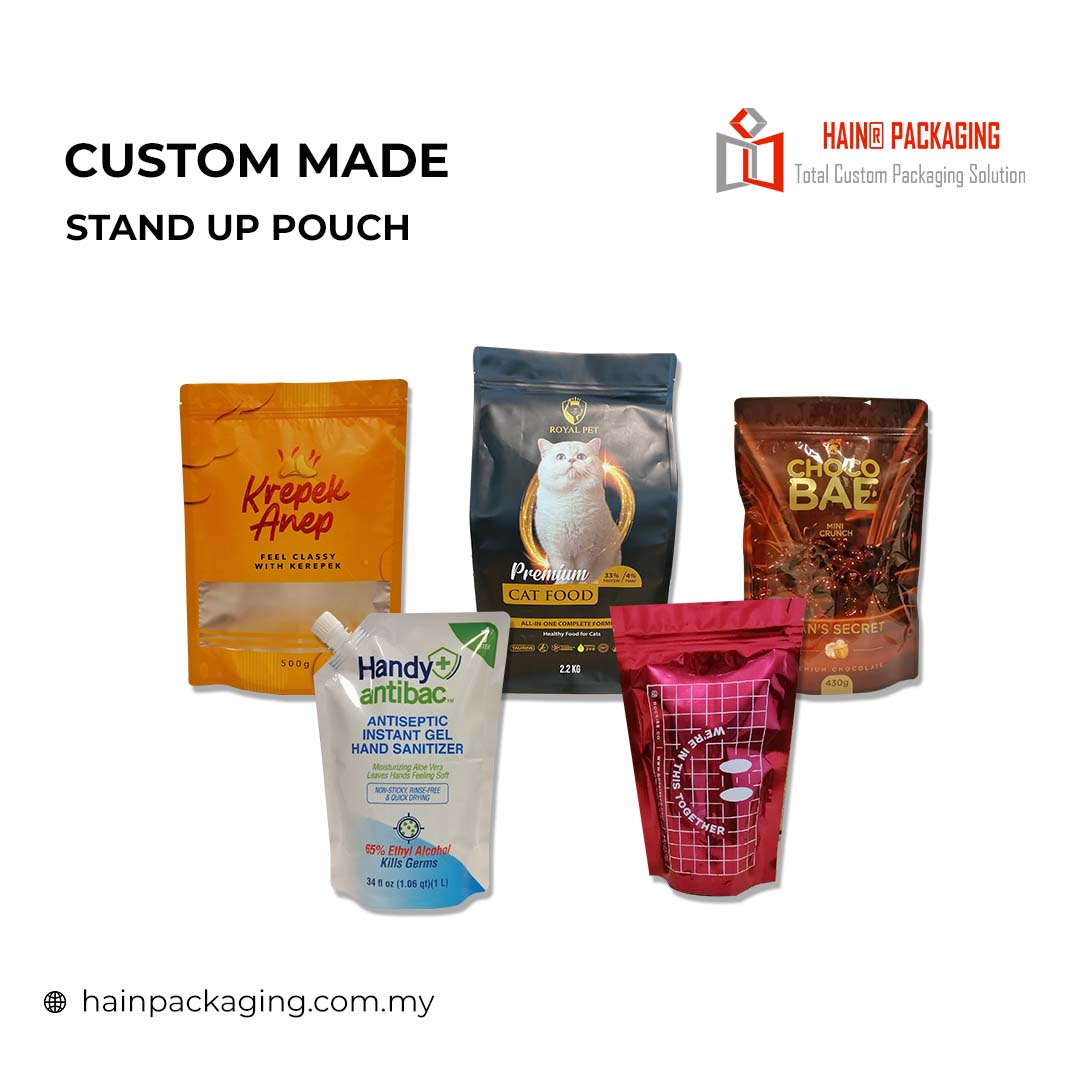
The final technical row is what the customer actually sees. Stand up pouches offer generous front-of-pack area, a stable standing profile and a surface that takes print treatment well, which is why brands lean on them for shelf impact. Matte finishes, spot varnish and tactile effects can all be specified, provided the finish survives filling and handling.
Retort packs also print well, but the design has to respect the realities of heat processing and the flatter, often cartoned presentation. Dark ink blocks over seal areas, fine type near folds and finishes that scuff during processing all need checking before artwork is frozen. If your brand relies on a premium matte look, raise that in the same conversation as the structure; the finish has to be compatible with the film and the process, not added afterwards.
Proofing is the practical bridge between artwork and production. Ask to see a proof on the actual proposed substrate, not on paper, because colour and finish can shift on a metallised or matte film. Check the small text and any fine rules at real size, and confirm where the seal area sits relative to the design. A design that looks sharp on screen can lose detail once it is printed on a flexible surface that will later be filled and handled.
How to score retort pouch vs stand up pouch on your own brief
Now turn the five rows into a decision you can defend. Give yourself a short scoring sheet and mark each row against your product rather than against a generic idea of what is better.
- Heat process: does the product need in-pack cooking? If yes, the retort format leads decisively.
- Barrier and storage: what must the pack keep out, and in what storage conditions? Note the structure each supplier proposes.
- Fill, closure and handling: which line will fill it, must it stand on shelf, and will the customer reseal it?
- Tooling and quantity: can your volume support the tooling, and have both suppliers priced the same brief?
- Artwork and finish: will the design survive the process and the handling it will get in store?
Score each row as a clear lead, a tie or a blocker. A retort pouch vs stand up pouch comparison rarely ends with one format winning every row; it ends with one format having no blockers and a lead where it matters most to you. If a row is a blocker — for example, you need in-pack cooking but have chosen a format that cannot take it — the decision is made for you, and it is better to discover that on paper than after a deposit is paid.
Keep the scores short and evidence-based. A row marked “tie” is fine; a row marked “blocker” needs a name and a reason attached, because that is the point where the decision stops being a matter of preference. If two formats both have no blockers, choose on the criteria that matter most to your business — perhaps shelf presence for a retail brand, or line compatibility for a co-packer with existing equipment. Write the reasoning next to the score so the next person in the room can follow it.
Where the comparison stops: questions a supplier must answer
A matrix narrows the field; it does not replace a conversation. Three questions usually remain when the rows are scored. First, can the supplier confirm the exact process the proposed film is built for, and how is the seal checked after it? Second, what does the quoted price include — tooling, artwork, sampling, closure assembly — and what would change it? Third, what is the confirmation route from sample to bulk, and what should you see before you commit?
Be cautious of any retort pouch vs stand up pouch claim that ignores your product. “This format is always cheaper” and “that format always lasts longer” are both shortcuts that fall apart when the specification changes. Ask for the reasoning, the test condition and the assumption behind the answer. A supplier who explains the trade-off is more useful than one who declares a winner.
This is also the point to ask about the path from sample to bulk. A sample that was made by hand can look excellent while hiding line problems that only appear at production speed. Ask what confirmation the supplier recommends before a first full order, and what you should be looking for when it arrives. A short, written set of expectations is worth more than a confident verbal assurance, because it gives both sides something to refer to if the first run behaves differently.
One last check before you commit: ask to see the pack filled, not just empty. An empty sample tells you about print and structure; a filled one tells you whether the base holds, whether the closure feels right in the hand and whether the product sits where the design expects it. Twenty minutes with a filled sample often settles arguments that a spreadsheet cannot, and it gives the whole matrix a reality check before the decision is written down.
FAQ
Can a stand up pouch replace a retort pouch for shelf-stable food?
Only if the product does not need in-pack cooking. If shelf stability comes from a separate cooking step before filling, a stand up pouch with the right barrier can be appropriate. If the food is cooked inside the sealed pack, the structure must tolerate that process, and a standard stand up pouch is not the format for it. Confirm the process requirement with your supplier before you compare prices.
Which format costs less at a small order quantity?
It depends on the specification and the order quantity. At small volumes, setup recovery and tooling often matter more than the film itself, so the cheaper format on one run is not necessarily cheaper on the next. Ask for both quotes against the same brief — same size, structure, closure, artwork and quantity — and compare the like-for-like answer rather than the headline number.
Do both formats need the same barrier structure?
No. Barrier is chosen for the product and the process, not for the shape of the pack. A retort pack may combine a heat-resistant structure with barrier layers suited to long ambient storage, while a stand up pouch may prioritise aroma, moisture or oxygen control for a different product. Compare the proposed structure against your own storage conditions instead of assuming the formats share a recipe.
Conclusion: pick the format, then run a line trial
The retort pouch vs stand up pouch decision becomes manageable when you stop treating it as a beauty contest and start scoring five rows: heat process, barrier and storage, fill and handling, tooling and quantity, and artwork finish. One row usually decides it — in-pack cooking for a retort pack, or resealability and shelf presence for a stand up pouch. Once the rows are scored, the shortlist is short enough to test properly.
A line trial is the last step, not an optional extra. Run the shortlisted format with your product on your equipment, check the seal and the handling, and record what passed and what drifted. That record turns a paper comparison into a decision you can repeat on the next order.
Talk to Logos Sendiri about your format choice
If you are weighing retort pouch vs stand up pouch for a new product, the team at Logos Sendiri can walk through the five rows against your process, product and quantity, and help you build a brief two suppliers can price fairly. Describe your project to us and we will help you shortlist the format with the fewest blockers.