Stick Pack vs Sachet: Best Small Pack Format
May 22, 2026
Frozen Food Packaging Materials: All Types Compared
May 22, 2026
Frozen Food Packaging Guide: Freezer-Safe Films for Malaysian Manufacturers
When your business relies on the cold chain, every packaging decision affects product quality, brand perception, and bottom-line returns. This frozen food packaging guide covers everything Malaysian manufacturers need to know about freezer-safe films — from material selection and category-specific solutions to shelf-life optimisation and regulatory compliance. Whether you pack frozen dim sum, seafood, vegetables, ready meals, or ice cream, the right film structure keeps your product in peak condition from factory freezer to consumer table.
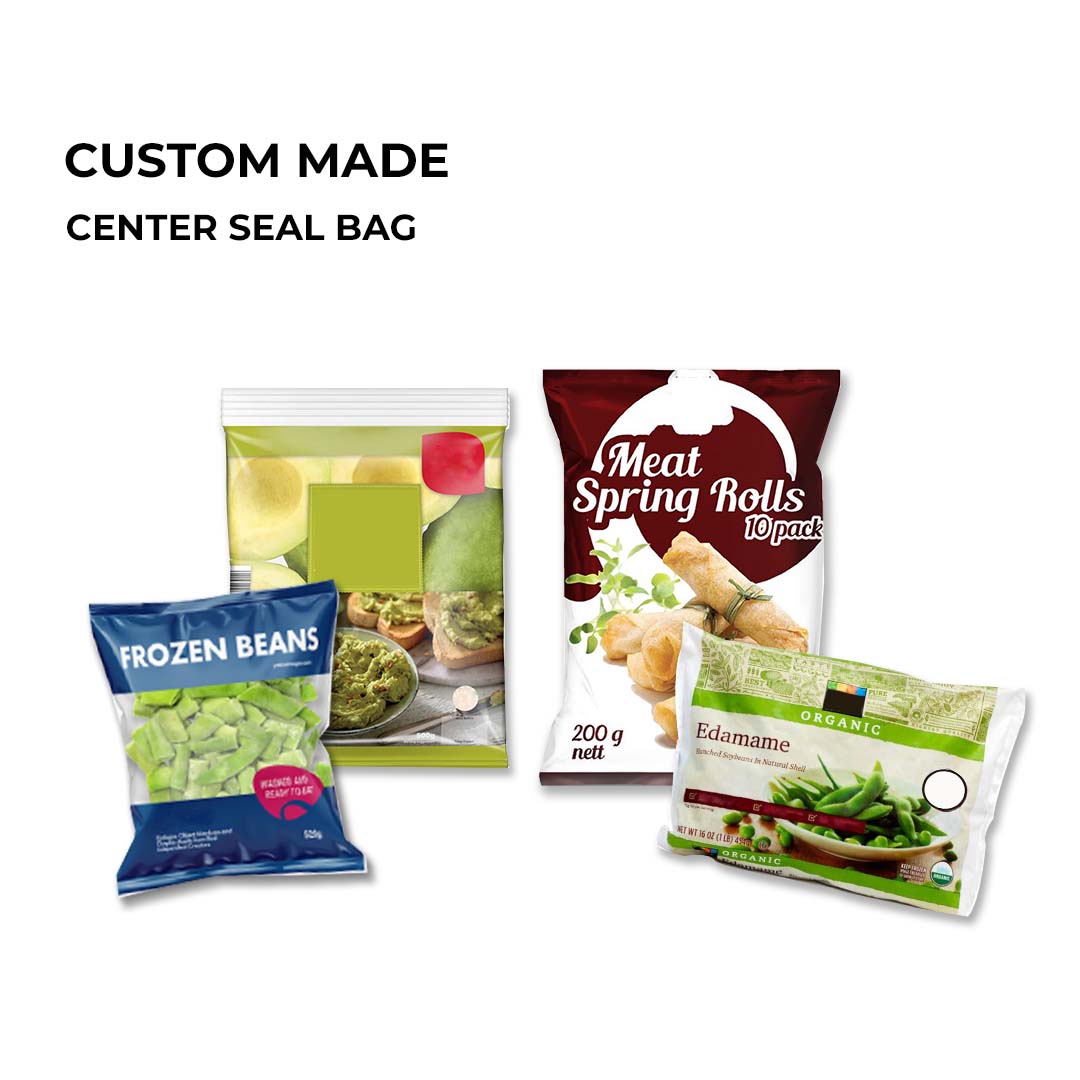
Why Frozen Food Packaging Matters in Malaysia
Frozen Food Packaging Guide — Malaysia’s frozen food market is a multi-billion ringgit industry, projected to exceed RM 8 billion by 2027 according to Ken Research. The surge in demand spans frozen dim sum, popiah, seafood, ready-to-eat meals, vegetables, and ice cream — driven by urbanisation, dual-income households, and the convenience economy. The Malaysian plastic packaging market itself is growing at a CAGR of 3.86% through 2031 (Mordor Intelligence).
For frozen food manufacturers, the cold chain in Malaysia presents unique challenges. High ambient temperatures (averaging 28–33°C year-round), frequent thunderstorms causing power fluctuations, and long distribution distances from factories in Selangor, Johor, or Penang to retail outlets across East Malaysia and Singapore all place extreme demands on frozen food packaging. A film that performs well in a temperate climate may fail in Malaysia’s tropical conditions if not properly engineered for the specific stresses of the ASEAN cold chain.
For frozen food manufacturers, the packaging is not merely a container — it is the primary barrier against freezer burn, moisture loss, odour transfer, and temperature abuse. A well-designed freezer-safe film extends shelf life, preserves texture and flavour, and communicates brand value at the point of sale. Poor packaging, conversely, leads to product rejection, returns, and reputational damage. Whether you need frozen food packaging guide, choosing the right packaging partner is key to your success.
As a food packaging supplier in Malaysia, HAIN® Packaging offers SIRIM-certified freezer-safe films manufactured to international food-grade standards. Our films undergo rigorous cold-chain testing to ensure performance at temperatures as low as -40°C.
What Makes a Film Freezer-Safe?
Not all plastic films are created equal when it comes to freezing. A truly freezer-safe film must maintain its physical and barrier properties at sub-zero temperatures without becoming brittle, cracking, or delaminating. Many Malaysian manufacturers discover this the hard way — a film that works perfectly for room-temperature snacks or dry goods can shatter like glass when subjected to frozen storage conditions.
Understanding the difference between a standard plastic bag and a purpose-engineered freezer film is critical. Standard packaging films are typically designed for ambient or chilled storage (0–4°C). When exposed to freezing temperatures, the polymer chains contract and stiffen. If the material lacks sufficient low-temperature flexibility, the film becomes brittle, micro-cracks form at stress points (especially seals and folds), and the packaging loses its barrier integrity. This is why using food-grade LDPE or generic poly bags for frozen applications leads to freezer burn, seal failure, and product loss.
Here are the critical performance criteria for genuine freezer-safe films:
- Low-temperature flexibility — The film must remain flexible at -18°C to -40°C without cracking during handling, dropping, or transportation.
- Moisture barrier (WVTR) — Water Vapour Transmission Rate must be low enough to prevent moisture migration from the product to the surface, which causes freezer burn.
- Oxygen barrier (OTR) — For products susceptible to oxidation (seafood, fatty meats, ready meals), oxygen transmission must be controlled to prevent rancidity.
- Seal integrity at low temperatures — Heat seals must remain intact when subjected to cold-chain vibration and temperature cycling.
- Puncture and tear resistance — Frozen products with sharp edges (bone-in meat, frozen vegetable stems) require films that resist puncture at low temperatures.
HAIN® Packaging tests all freezer-grade films according to ASTM and ISO standards, with verified performance down to -40°C for multi-layer laminates. For a deeper look at material science, read our food packaging materials guide covering LDPE, HDPE, and PP properties.
Beyond the physical properties of the film itself, the design of the package plays a significant role in freezer performance. A center-seal bag with gusseted sides, for example, distributes stress more evenly than a simple pillow pouch when filled with frozen product. Stand-up freezer pouches with reinforced bottom gussets offer better stackability in retail freezers. Features like tear notches, zipper reseals, and peelable seals all need to be engineered for low-temperature operation — a zipper that works at room temperature may become stiff or break at -18°C if not specified for freezer use.
Frozen Food Categories & Film Requirements
Different frozen food categories place different demands on packaging films. Below we break down the key requirements for Malaysia’s major frozen food segments.
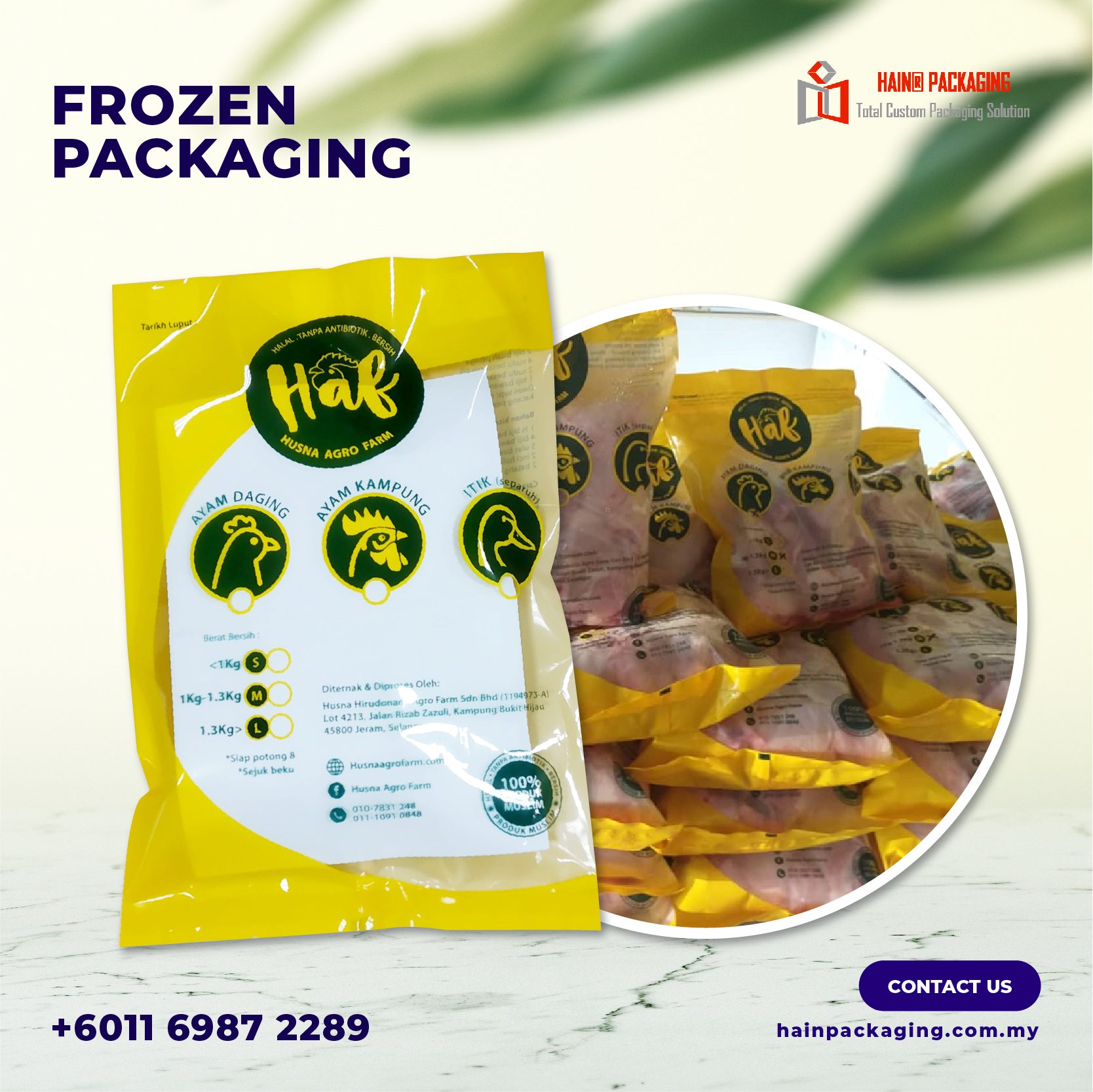
Frozen Meat & Poultry
Frozen meat and poultry represent the largest segment of Malaysia’s frozen food market. Beef, chicken, and mutton products require high-barrier films that prevent moisture loss, odour migration, and oxidation.
Recommended film structure: NY/LDPE (Nylon/Polyethylene) or PET/NY/LDPE laminates. Nylon provides puncture resistance and oxygen barrier, while LDPE supplies the heat-seal layer and moisture barrier. For premium exported meat, PET/AL/NY/LDPE with aluminium foil offers the ultimate protection, extending shelf life beyond 18 months at -18°C.
Common formats: Vacuum bags, center-seal pouches, and shrink bags. Center-seal pouches are increasingly popular for Malaysian meat brands because they offer full-surface custom printing and stand-up display capability.
Frozen Seafood
Malaysia’s seafood processing industry produces frozen prawns, fish fillets, crab, squid, and mixed seafood for both domestic and export markets. Seafood is particularly prone to odour transfer and lipid oxidation.
Key requirements: Ultra-high oxygen barrier (OTR < 5 cc/m²/day), strong odour barrier to prevent transfer to other products, and anti-fog properties for display clarity. PET/AL/NY/LDPE structures are standard for premium seafood brands exporting to Japan, Europe, and the US.
Shelf-life benefit: With proper barrier film, frozen seafood maintains quality for 12–18 months at -18°C versus 6–9 months in standard polyethylene bags.
Frozen Vegetables & Fruits
IQF (Individually Quick Frozen) vegetables and fruits — including mixed vegetables, corn, broccoli, frozen berries, and tropical fruits — require films that prevent piece adhesion and maintain product separation.
Film features needed: Anti-block additives in the inner PE layer prevent individual pieces from sticking to the film or each other. Smooth inner surface finish, easy-open tear notches, and transparent windows for product visibility are common requirements. LDPE-based films with moderate barrier are cost-effective for this category, while PET/NY/LDPE is recommended for premium export packs.
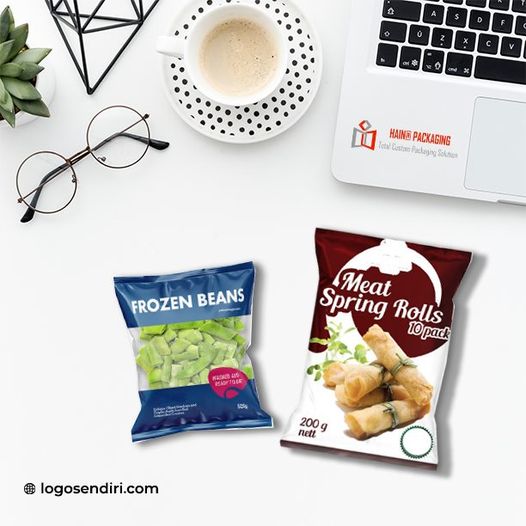
Typical formats: Center-seal bags from 500g to 2.5kg, stand-up freezer pouches with zipper for retail, and bulk polythene bags for foodservice (5kg–25kg).
Frozen Ready Meals & Traditional Malaysian Fare
Malaysia’s ready-meal market is booming, with frozen nasi lemak kits, curry packs, rendang, and traditional kuih finding their way into freezer aisles nationwide. These products need packaging that survives both freezing and reheating.
Dual-function packaging: Many frozen ready meals are reheated directly in the packaging — either in a microwave, conventional oven, or boiling water. This requires dual-ovenable films such as CPET trays or heat-resistant PE/PA boil-in-bag structures. Stand-up freezer pouches with zipper reseal are ideal for multi-serve meals, allowing consumers to use a portion and reseal the rest.
For Malaysian frozen popiah and spring roll manufacturers, puncture resistance is paramount due to the sharp edges of the rolled product. We have a dedicated frozen popia packaging guide covering specific solutions for this category.
Frozen Ice Cream & Desserts
Ice cream, sorbet, frozen yogurt, and frozen dessert cakes present unique packaging challenges. The product is semi-solid at freezing temperatures, prone to ice crystal formation, and highly sensitive to temperature fluctuations.
Critical factors:
- Moisture barrier is king — Ice cream packaging must prevent moisture loss that leads to ice crystals and shrinkage. WVTR should be below 0.5 g/m²/day.
- Low-temperature impact resistance — Tubs and lids must not crack when dropped at -18°C to -25°C.
- Printability — Ice cream packaging relies heavily on vibrant graphics for impulse purchase appeal. Rotogravure printing on laminated films delivers premium visual impact.
- Resealability — For multi-serve tubs and pouches, resealable features (zipper, snap-on lid) maintain product quality after opening.
Common ice cream packaging formats include spiral-wound paperboard tubs with LDPE lining, PP injection-moulded tubs, and flexible stand-up pouches for artisanal and soft-serve ice cream brands. The growing trend of premium artisanal ice cream in Malaysia — using local flavours like durian, gula Melaka, and coconut — has driven demand for smaller-format (250ml–500ml) stand-up freezer pouches with clear windows that showcase product colour and texture.
For ice cream manufacturers exporting to Singapore, Brunei, and the Middle East, the packaging must also withstand longer transit times and less predictable cold-chain conditions. In these cases, PET/NY/LDPE laminates with oxygen barrier properties help prevent flavour degradation from oxidation, while the aluminium foil layer (in PET/AL/NY/LDPE structures) provides an absolute barrier for extended shelf life beyond 12 months.
Material Specifications for Freezer-Safe Films
Understanding the material specifications behind freezer-safe films helps you make informed purchasing decisions. Here is a detailed breakdown of commonly used film structures and their performance data.
Single-Layer Films
| Material | Thickness Range | Temp Range | WVTR (g/m²/day) | Best Use |
|---|---|---|---|---|
| LDPE | 50–150 µm | -18°C to 80°C | 1.0–1.8 | Bread, simple veg, dry goods |
| LLDPE | 40–120 µm | -20°C to 90°C | 0.8–1.5 | Improved puncture vs LDPE |
| MDPE | 60–150 µm | -20°C to 95°C | 0.6–1.2 | Intermediate barrier needs |
| HDPE | 30–100 µm | -20°C to 110°C | 0.3–0.7 | Stiff packaging, liners |
| PP (Cast) | 20–80 µm | -10°C to 120°C | 0.3–0.6 | Higher temp applications |
| BOPP | 15–40 µm | -10°C to 130°C | 0.2–0.5 | Overwrap, outer layer |
Multi-Layer Laminates
| Laminate Structure | Typical Thickness | Temp Range | OTR (cc/m²/day) | WVTR (g/m²/day) |
|---|---|---|---|---|
| NY15/LDPE75 | 90 µm | -40°C to 100°C | 15–30 | 0.5–0.8 |
| PET12/NY15/LDPE75 | 102 µm | -40°C to 110°C | 5–15 | 0.3–0.5 |
| PET12/AL7/NY15/LDPE75 | 109 µm | -40°C to 120°C | <0.5 | <0.01 |
| BOPA15/LDPE75 | 90 µm | -30°C to 110°C | 10–25 | 0.4–0.7 |
| EVOH-based (5-layer) | 70–120 µm | -30°C to 120°C | <2 | 0.2–0.4 |
Multi-layer laminates combine the strengths of individual materials. Nylon provides puncture resistance and oxygen barrier; PET adds stiffness, printability, and temperature resistance; aluminium foil provides an absolute barrier to light, oxygen, and moisture; LDPE supplies the heat-seal layer and flexibility at low temperatures.
For a complete comparison of packaging materials, refer to our plastic packaging material selection guide covering polyethylene, polypropylene, polyester, and more.
Shelf Life Data by Packaging Type
The shelf life of frozen food depends heavily on the packaging’s barrier properties. Below are typical shelf-life ranges for different packaging types at -18°C storage.
| Product Type | LDPE (months) | NY/LDPE (months) | PET/NY/LDPE (months) | PET/AL/NY/LDPE (months) |
|---|---|---|---|---|
| Frozen beef/chicken | 3–6 | 6–12 | 12–18 | 18–24 |
| Frozen fish (fatty) | 2–4 | 4–8 | 8–14 | 14–20 |
| Frozen fish (lean) | 4–6 | 6–10 | 10–16 | 16–22 |
| Frozen prawns/shrimp | 3–5 | 5–10 | 10–16 | 16–22 |
| Frozen vegetables | 6–10 | 10–14 | 14–18 | 18–24 |
| Frozen ready meals | 3–6 | 6–10 | 10–14 | 14–18 |
| Frozen dim sum/popia | 4–6 | 6–10 | 10–14 | 14–20 |
| Ice cream | 2–4 | 4–6 | 6–10 | 10–14 |
Note: Actual shelf life depends on product formulation, initial microbial load, freezing method (IQF vs blast vs slow), storage temperature stability, and packaging seal integrity. These figures assume consistent -18°C storage with no temperature abuse.
Custom Printing & Branding on Freezer Films
In Malaysia’s competitive frozen food aisle, packaging design is a critical differentiator. HAIN® Packaging offers custom printing on all freezer-safe films using two primary methods.
Rotogravure Printing
Rotogravure delivers the highest print quality with up to 10 colours, fine detail, and consistent reproduction across large runs. Ideal for established brands with consistent design requirements. Minimum order quantity: 10,000 pieces. All inks are food-grade, freezer-safe, and compliant with FDA and KKM regulations.
Flexographic Printing
Flexographic printing offers an economical alternative with up to 6 colours and faster turnaround times. Suitable for seasonal products, test launches, and smaller brands. Minimum order quantity: 5,000 pieces.
For more on packaging printing options, see our guide on packaging printing in Malaysia.
How to Select the Right Freezer Film for Your Product
Choosing the optimal freezer-safe film requires a systematic evaluation of your product, market, and operational parameters. Here is a practical decision framework used by HAIN® Packaging when advising Malaysian frozen food manufacturers.
1. Define your shelf-life target. Short shelf life (3–6 months) products like frozen bread and simple vegetables can use cost-effective LDPE or LLDPE films. Medium shelf life (6–12 months) such as standard frozen dim sum and meat benefit from NY/LDPE laminates. Long shelf life (12–24 months) for premium seafood or exported products requires PET/NY/LDPE or PET/AL/NY/LDPE structures.
2. Assess product characteristics. Products with high fat content (fatty fish, chicken skin, fatty meat cuts) oxidise faster and need higher oxygen barrier from nylon or EVOH layers. Products with sharp edges (bone-in meat, frozen vegetable stems) need puncture-resistant outer layers. Products with strong odours (seafood, spices) need odour-barrier films to prevent cross-contamination in shared freezers.
3. Consider your distribution channel. Products sold through hypermarkets and supermarkets (Jaya Grocer, AEON, Village Grocer) face more handling, longer display times, and greater temperature variability than products shipped directly from factory to foodservice. For retail channels, packaging aesthetics — print quality, gloss, and transparency — become almost as important as barrier performance. Stand-up pouches with zipper reseal command premium shelf positioning in freezer aisles.
4. Evaluate your cold-chain reliability. Manufacturers with full cold-chain control (factory freezer → refrigerated truck → retail freezer) can use thinner, more cost-effective films. Those exporting to destinations with less reliable cold chains should invest in higher-barrier laminates with aluminium foil or EVOH to compensate for temperature abuse.
5. Factor in your budget and MOQ. LDPE bags start at minimal cost and MOQ of 5,000 pieces for flexographic printing. NY/LDPE laminates increase cost by approximately 30–50% over LDPE but offer significantly better performance. Premium PET/AL/NY/LDPE structures cost roughly 2–3x standard LDPE but can justify the investment through extended shelf life and reduced product waste. HAIN® Packaging works with businesses of all sizes to match the right film structure to their specific budget constraints.
For a broader perspective on matching packaging to product type, see our custom food packaging guide for Malaysian F&B businesses covering everything from material selection to design considerations.

Quality Standards & Testing for Frozen Food Packaging
Frozen food packaging must comply with rigorous quality standards. HAIN® Packaging implements comprehensive testing protocols aligned with international benchmarks.
Cold Chain Simulation Testing
- Temperature cycling — -40°C to room temperature, 10 cycles, simulating cold-chain breaks
- Seal integrity at -18°C — 72-hour storage test with seal strength verification
- Flex crack resistance — Repeated flexing at -18°C to simulate transportation handling
- Impact resistance — Drop testing from 1 metre at -18°C
- Puncture resistance — Measured per ASTM D3763 at sub-zero temperatures
Regulatory Compliance
All HAIN® Packaging frozen food films are manufactured in compliance with:
- KKM (Malaysia Ministry of Health) — Food contact material regulations
- FDA (US Food and Drug Administration) — 21 CFR for food contact substances
- EU Regulation No 10/2011 — Plastic materials and articles intended to come into contact with food
- SIRIM — Malaysian standards certification for quality management
Frequently Asked Questions
What temperature range do frozen food bags withstand?
Standard LDPE bags are rated to -18°C. NY/LDPE and PET/NY/LDPE laminates are tested to -40°C, making them suitable for deep-freeze applications and export cold chains.
What is the best film for frozen meat packaging?
For frozen meat and poultry, NY/LDPE or PET/NY/LDPE laminates offer the best balance of puncture resistance, oxygen barrier, and cost. For premium cuts destined for export, PET/AL/NY/LDPE provides maximum protection.
How do I prevent ice crystals in frozen food packaging?
Use high-moisture-barrier films (WVTR below 0.5 g/m²/day), minimise headspace in the bag, maintain consistent -18°C storage, and ensure strong heat seals. Quick freezing (IQF) also reduces ice crystal formation significantly.
Can frozen food bags be custom printed with my logo?
Yes. HAIN® Packaging offers both flexographic (MOQ 5,000) and rotogravure (MOQ 10,000) printing on all freezer-safe films. All inks are food-grade and freezer-safe.
What size options are available for frozen food pouches?
From 100g snack pouches to 5kg bulk bags. Stand-up freezer pouches with zipper from 250g to 2kg are the most popular retail format. Center-seal bags range from 200g to 3kg for frozen vegetables and meat. Custom sizes are always available.
Are HAIN frozen food bags certified for food contact?
Yes. All HAIN® Packaging frozen food films are KKM, FDA, and EU food-contact certified for use at freezer temperatures.
Ready to Upgrade Your Frozen Food Packaging?
Choosing the right freezer-safe film is one of the most important decisions a frozen food manufacturer can make. The right packaging protects your product, extends shelf life, strengthens your brand, and ultimately drives repeat purchases.
At HAIN® Packaging, we combine technical expertise with manufacturing capability to deliver frozen food packaging solutions tailored to your product category, volume, and budget. Our team can advise on material selection, film structure, printing options, and compliance requirements. For businesses exploring frozen food packaging guide, finding the right packaging partner is essential.
Contact us today via WhatsApp or email [email protected] for a free consultation and quotation.