
Why Does Spout Pouch Dispensing Control Fail at the Seal?
November 19, 2026
Retort Pouch With Zipper: A Buyer’s Spec Checklist
November 21, 2026Key takeaways – A cheap unit price is not a cheap order. Setup, plates, wastage and unsold stock decide what a sachet really costs a small brand. – Powder is the hard case. Barrier and seal integrity, not the artwork, decide whether a seasoning sachet survives the journey to a shop shelf. – Stick packs and sachets are not interchangeable; the fill format changes your minimum order, your film and your print layout. – A mockup showing “YOUR LOGO HERE” is a sales picture, not print-ready artwork. Separation, bleed and registration still have to be done. – Ask what the film is rated for and confirm timing with sales before you order. A short pre-quote checklist prevents most of the expensive surprises.
If you are comparing sachet printing Malaysia suppliers for a small-batch food brand, the costliest mistakes rarely look costly at the start. They arrive disguised as helpful suggestions: a sample that uses a generic logo, a quote that assumes you want ten times your real volume, a film picked because it looked glossy on a swatch. By the time the problem shows itself, it is no longer a design conversation but a pallet of packs you cannot sell, or a launch date you have to move. This article is built around seven of those mistakes, the ones that quietly ruin small brands instead of failing loudly enough to get noticed.
Each section follows the same shape. First comes the assumption most buyers walk in with, then what actually happens on a Malaysian flexible packaging line, and finally the specific change that stops the problem recurring. The focus is on food powders, seasonings and drink mixes, because that is where small brands here concentrate and where the sachet format is most often misunderstood. We write from the point of view of a local supplier, so the emphasis sits on decisions you can verify with a sample and a straightforward conversation, rather than on ideals that only exist in a brochure.
You Think Bigger Runs Always Cost Less Per Sachet — The Actual Unit-Cost Maths in Sachet Printing Malaysia
What you think. The first quote arrives with a per-piece price, and the larger quantity column always looks better. The logic feels unanswerable: if ten thousand sachets cost less each than two thousand, then ordering more must be the thrifty choice. So a small brand stretches its budget, commits to a run that feels impressively large, and assumes the saving is already banked.
What actually happens. The printed figure is only one line in a much longer calculation. Cylinder or plate charges, setup time on the press, ink mixing, slitting waste and start-up spoilage are spread across the run, which is why the unit number falls as volume rises. But those savings can be erased by the things that do not appear on the quotation: capital tied up in stock, warehouse space, stock going out of date before it is used, and the cost of changing your design whilst eighteen months of packaging sits in a store room. For a small brand still learning what customers want, a large run is not thrift. It is a bet that nothing will change, and nothing ever stays still.
The fix. Compare total landed cost per saleable sachet rather than the headline piece price, and include the money you will spend storing and eventually replacing old stock. When you request a sachet printing Malaysia quote, ask for the cost breakdown rather than a single number, so you can see which charges are fixed and which scale with volume. Our notes on how small-quantity runs change the unit cost set out the same arithmetic from the buyer’s side and are worth reading before you commit to a quantity.
| Cost line | Small run (e.g. 2,000) | Large run (e.g. 20,000) | What actually drives it |
|---|---|---|---|
| Printed unit price | Higher | Lower | Setup and plate charges spread over more pieces |
| Setup and plate charge | Same absolute cost | Same absolute cost | Fixed per design, regardless of quantity |
| Start-up spoilage | Higher per piece | Lower per piece | Press stabilises after the first few hundred metres |
| Cash tied up in stock | Low | High | Paid up front, recovered only as packs are sold |
| Storage and obsolescence | Low | Potentially high | Space, handling and expired designs |
| Cost of a design change | Low | High | Old packs cannot be reprinted or reused |
Read the table as a whole rather than as a race to the bottom row. A larger run genuinely wins on the first three lines and genuinely loses on the last three. Which side dominates depends on how fast your product sells and how settled your artwork is. For a first order, or for a seasonal flavour you are still testing, the lower committed spend of a small run is usually the more honest choice even though the per-piece number looks worse.
You Think Any Sachet Printer in Malaysia Can Handle Powder — Actual: Barrier and Seal Integrity Decide
What you think. Printing is printing. If a supplier can put your logo on a flat film and make a three-side seal, the machine obviously knows how to pack a seasoning. Many new brands therefore choose on artwork quality and price, assuming that the contents are the easy part.
What actually happens. Powder is the difficult case in flexible packaging, and it exposes weak specifications quickly. Fine particles migrate into the seal area and prevent a clean weld, so a sachet that looked perfect on the press develops a slow leak in the carton. Hygroscopic powders pull moisture through a film that would be perfectly adequate for a dry snack, and the contents clump on shelf. Oily seasonings can attack the wrong sealant layer. A supplier who is set up mainly for flat, dry products may produce attractive sachets that fail precisely where a small brand cannot afford a failure: in the customer’s hand.
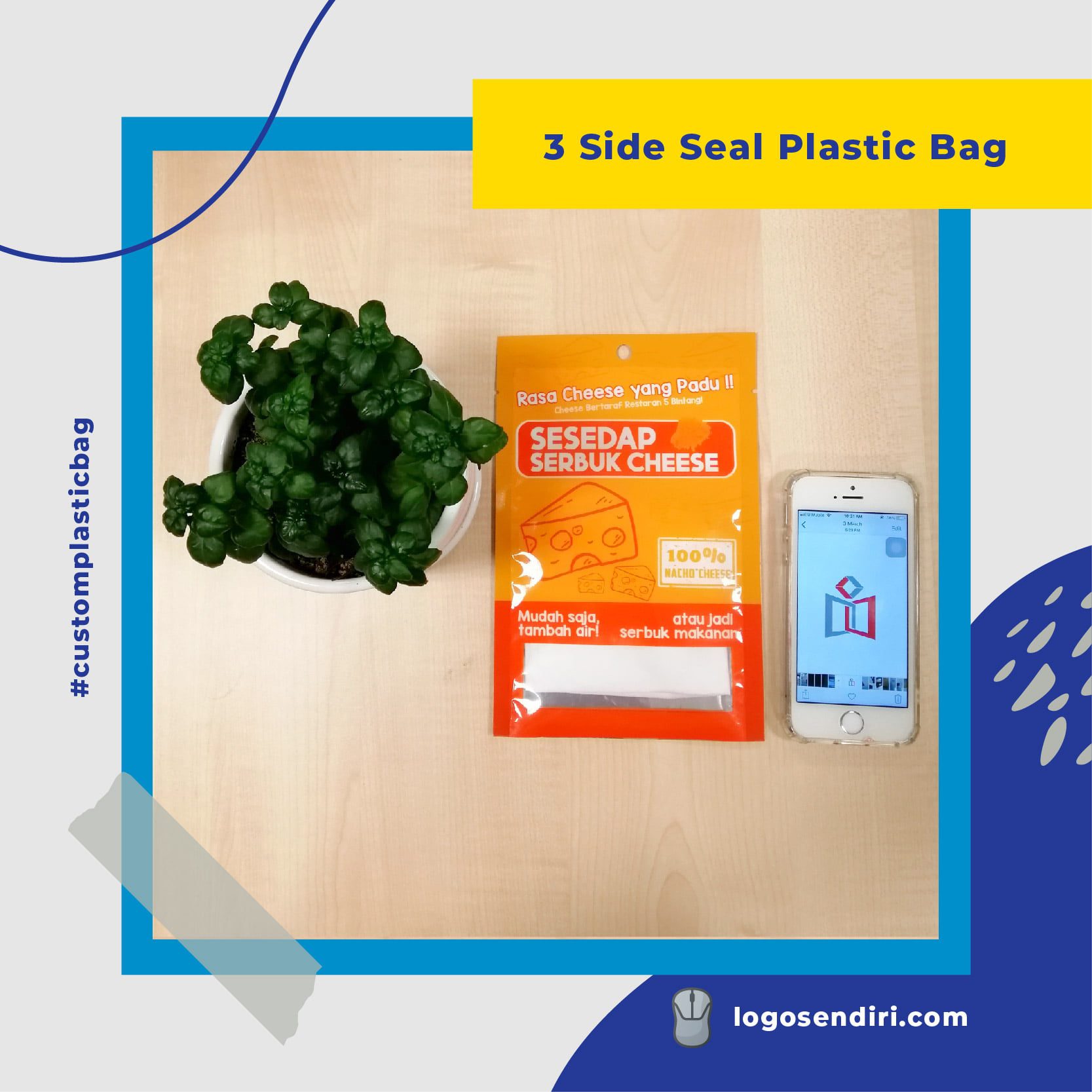
The fix. Ask about the film structure and the seal window before you discuss colours, and insist on a peel test rather than a visual check. The orange and yellow three-side seal sachet below is the kind of format commonly used for cheese powder and seasoning; the appeal is obvious, but what matters is the laminate underneath and the cleanliness of the seal land at the moment of welding.
A good supplier will talk about barrier performance, seal strength and product behaviour rather than just about artwork. If the conversation stays on colours, that is a signal. The technical articles hosted by the Food Packaging Forum are a useful background read on how moisture and migration interact with a film, and they help you ask better questions when a sachet printing Malaysia supplier starts describing materials.
You Think Stick Packs and Sachets Are Interchangeable — Actual: Fill Format Changes Your MOQ in Sachet Printing Malaysia
What you think. A stick pack and a three-side seal sachet look like the same idea in different shapes, so choosing between them feels like a styling decision. Brands often pick the one that appears more modern and only later discover that the choice has quietly rewritten the order.
What actually happens. The two formats run on different filling equipment, use different film widths and demand different print layouts. A stick pack is narrow, usually filled by a multi-lane machine, and sold in high counts; a three-side seal sachet is wider, easier to print on and often the more practical choice for a small brand with a single product. The minimum order follows the machinery. A supplier set up for high-count stick packs may not want a short run at all, whilst a sachet line can often accommodate a modest first order. Changing format after artwork is approved means new cylinders, new sealing parameters and a fresh discussion about quantity, which is why the format decision belongs near the start, not the end.
The fix. Decide the fill format before you ask for a minimum order, and tell the supplier the exact fill weight and product behaviour at the same time. The “YOUR LOGO HERE” mockup below is a three-side seal sachet; treat the shape as part of the specification, not as decoration.

If you are still weighing the two, our stick pack versus sachet comparison walks through how fill format, speed and volume interact. For any sachet printing Malaysia enquiry, naming the format first produces a far more useful answer than asking for a price and hoping the supplier guesses your intent.
You Think a “Your Logo Here” Mockup Is Print-Ready Artwork — Actual: Separation, Bleed and Registration
What you think. The sample arrives with a neat rectangle where the logo will go, and it looks finished. It is tempting to approve it and assume the factory will simply drop your artwork into that space, exactly as shown.
What actually happens. A mockup is a sales picture, not a production file. It shows placement and colour mood, but it says nothing about how the artwork will be separated into print colours, whether there is enough bleed around the edges, or how tightly the colours will line up on a moving film. Text set too close to a seal can be swallowed by the weld. Fine type and thin lines can fill in at small size. A photograph that looks sharp on a screen may break up when printed at sachet scale, and a background colour that reaches the very edge without bleed leaves a hairline of unprinted film. Mockups also routinely show a brand name or logo that is not yours, which is helpful for imagination and useless for production.
The fix. Supply vector artwork where possible, confirm the bleed and safe-area requirements with your printer, and ask to see a proof or a printed sample before the full run. Notice how the two mockups in this article look similar: the second one below has the same “YOUR LOGO HERE” message but a different layout and background, and neither is a finished artwork file. Comparing them is a good way to understand why a mockup should be judged for structure and position, never treated as the final image.

A short pre-press conversation removes most of this risk. Ask which file format the printer prefers, how much bleed they need, and whether a digital proof is available. These questions cost nothing and prevent the most common source of reprinted, wasted stock. They are also a reliable test of a supplier: a printer who welcomes them is used to working with careful small brands.
You Think More Colours Always Mean Better Shelf Appeal — Actual: Registration and Cost at Small Scale
What you think. More colours look richer, so the natural instinct is to ask for the fullest design the budget allows. A small brand competing beside established names feels pressure to look equally bold, and extra ink seems like the cheapest way to do it.
What actually happens. Every additional colour may mean another plate or cylinder, another setup, another ink to mix and another chance for the colours to drift out of alignment on a fast-moving film. Registration is the quiet constraint: the closer the inks sit to one another in the design, the more visible any misalignment becomes, and a sachet is a small canvas where a fraction of a millimetre is easy to see. At low volume, fixed plate costs do not spread far, so a five-colour design can cost noticeably more per piece than a two-colour one without delivering a proportional return on shelf. There is also a practical point about legibility: a busy, heavily inked sachet can make a small brand look less clear, not more premium.
The fix. Choose the smallest number of colours that still carries your identity, then use contrast, layout and finish to do the heavy lifting. Ask your printer where the break-even sits between process and spot colours for your quantity. Industry bodies such as the Institute of Packaging Professionals publish general material on print and converting that is useful for understanding these trade-offs without being tied to one supplier’s equipment. The goal is not the most colours but the most legible, repeatable result at your volume, and that is often a simpler design than you first imagined.
You Think “Food-Safe” Is a Given — Actual: Ask What the Film Is Rated For
What you think. A food brand assumes that any film sold for packaging food must suit its particular food. The phrase “food-safe” sounds complete, so buyers rarely ask what lies behind it, especially when a supplier is pleasant and the sample looks clean.
What actually happens. Suitability depends on the interaction between the film and the contents. A laminate that performs well with a dry, low-oil powder may behave differently with a spicy seasoning high in chilli oil or a drink mix with acid. Barrier needs change with humidity, and the sealant layer has to tolerate the temperature at which the product is filled. What matters in practice is a clear description of the structure and what it was developed to hold, together with a technical data sheet you can keep on file. Generic assurances do not tell you how a pack will behave after six weeks in a warm distribution chain, and they do not help you compare two suppliers. This is why the question to ask is not whether a film is “food-safe” in the abstract but what it is rated for in your specific application.
The fix. Describe your product precisely, including oil content, acidity and whether it is filled warm, and ask the supplier to recommend a structure with the reasoning behind it. Keep the technical data sheet with your specification, and keep the discussion focused on food powders, seasonings and drink mixes, which is where the sachet format earns its place. A sachet printing Malaysia supplier who asks about your product before recommending a film is telling you something useful about how they work, and that willingness to discuss detail is a better signal than any general claim.
You Think Lead Time Is a Fixed Number — Actual: It Depends on Spec and Order Volume
What you think. Somewhere in the negotiation a number appears, and from that moment it hardens into a promise in your planning spreadsheet. You build the launch around it and start booking other work against it.
What actually happens. Timing is not a property of the supplier alone; it is an outcome of your specification. The number of colours, the film structure, whether new cylinders are needed, the quantity ordered and where the job sits in the production schedule all move it. A simple unprinted format and a multi-colour printed run with new tooling are different propositions, and treating them as the same leads to disappointed launch plans. Published figures are useful only as broad orientation, never as a date you can hold a supplier to.
The fix. For any sachet printing Malaysia project, state that lead time depends on the specification and on the order volume, and confirm the current position with the sales team before you place an order. Build a little slack into your own launch plan and agree in writing how any change to artwork or quantity affects the sequence. This is a conversation, not a number you can lift from a website, and approaching it that way saves both sides from a difficult week later.
You Think One Supplier Fits Every Stage — Actual: Match MOQ to Your Launch Phase
What you think. Finding a supplier feels like finding a partner for life, so the instinct is to choose one and stay loyal through every stage of growth. Loyalty is commendable, but it can quietly hold a small brand back.
What actually happens. A supplier whose minimum order suits a launch may be wrong for a brand shipping several thousand packs a week, whilst a high-volume printer built for large contracts may have no interest in a first run of five hundred. Needs change as a product moves from a kitchen-table test to a shop shelf to a regional distributor. The right relationship at one stage can become the wrong one at the next, not through any fault on either side, but because the economics of the order have changed. This is particularly visible with powders, where a curry blend that starts as a single sku becomes a range of flavours, each with its own artwork and its own minimum.
The fix. Match the minimum order to the phase you are actually in, and revisit the match at each stage of growth. Do not be afraid to run a small first order to learn what sells, then move to a supplier structured for scale once demand is proven. Our page on custom curry powder sachets illustrates how a powder product and its sachet specification develop together, which is the kind of thinking that should sit behind a phase-appropriate order. Choosing deliberately at each stage beats choosing once and hoping.
The Fix-It List: Seven Corrections Before You Request a Sachet Printing Quote
If you take one thing from this article, let it be this: most sachet problems are decided before the quote is requested, not after the order is placed. Work through these seven corrections and the conversation with any supplier becomes shorter, clearer and harder to get wrong.
- Price the whole order, not the piece. Ask for the cost breakdown and include storage and obsolescence in your comparison, so the cheap headline number does not mislead you.
- Name the fill format first. Decide between a stick pack and a three-side seal sachet before you ask about minimums, and give the supplier the fill weight and product behaviour at the same time.
- Treat powder as the hard case. Ask about barrier and seal integrity, and require a peel test rather than a visual inspection of the sample.
- Send print-ready artwork. Provide vector files, confirm bleed and safe areas, and approve a proof before the full run. A mockup is a starting point, never a production file.
- Keep colours deliberate. Choose the fewest colours that carry your identity and ask where the cost break-even sits at your volume.
- Ask what the film is rated for. Describe the oil, acidity and fill temperature of your product and keep the technical data sheet on file. Keep the discussion on food applications only.
- Confirm timing with sales. Recognise that timing depends on specification and order volume, and agree the position before you commit to a launch date.
None of these corrections is expensive. Together they change the quality of the answer you get from a sachet printing Malaysia supplier, because you are now asking about the variables that actually decide whether an order works. A supplier who engages with the list is showing you how they work, which is often more informative than the quotation itself.
Frequently Asked Questions
What is a realistic minimum order for a small brand? It depends on the format, the film and the number of colours, so there is no single figure that fits every product. A simple three-side seal sachet is usually more accessible at low volume than a multi-lane stick pack. Ask for the minimum against your exact specification rather than accepting a general number.
Why do powder sachets leak when the sample looked fine? The usual cause is product entering the seal land and interrupting the weld, or a film without enough barrier for a hygroscopic powder. Both are invisible on a finished sample. A peel test and a clear description of the film structure will tell you more than a visual check.
How is lead time actually decided? It depends on the specification and on the order volume, including colours, film and whether new tooling is required. Confirm the current position with sales before placing an order, and agree how any change to artwork or quantity affects the schedule.
What artwork files should I send? Vector files are preferred, with bleed and safe areas confirmed against the printer’s template. Ask whether a digital proof is available and approve it before the run. A mockup showing a placeholder logo is not a production file.
Can I switch from stick packs to sachets later? You can, but it is a specification change rather than a cosmetic one: different film width, different filler, different print layout and a different minimum order. Decide the format early and revisit it only with a clear reason.
Conclusion: Get Sachet Printing Malaysia Right Before You Order
A sachet is a small object with a surprisingly long list of decisions behind it. The seven mistakes in this article all share one feature: they look minor at the moment they are made and expensive once the packs are in your hands. Ordering big to chase a lower unit price, assuming any printer can handle powder, treating a mockup as artwork, piling on colours, accepting a vague food-safe claim, treating timing as a fixed number and staying with one supplier through every stage of growth. Each one is avoidable with a short, specific conversation before the order is placed.
The habit that prevents most of them is simple. Describe your product precisely, decide the fill format early, ask how the film and seal are specified, and compare total cost rather than a single price. If you are at the point of requesting a sachet printing Malaysia quote, work through the fix-it list first and bring the answers with you; a supplier who can discuss those points fluently is far more likely to deliver a pack that works in the real world. You can discuss your sachet printing requirements with us and we will work back from your product and volume to a specification that fits the stage your brand is in.