
pet food pouch malaysia: Buyer Guide | Logos Sendiri
November 26, 2026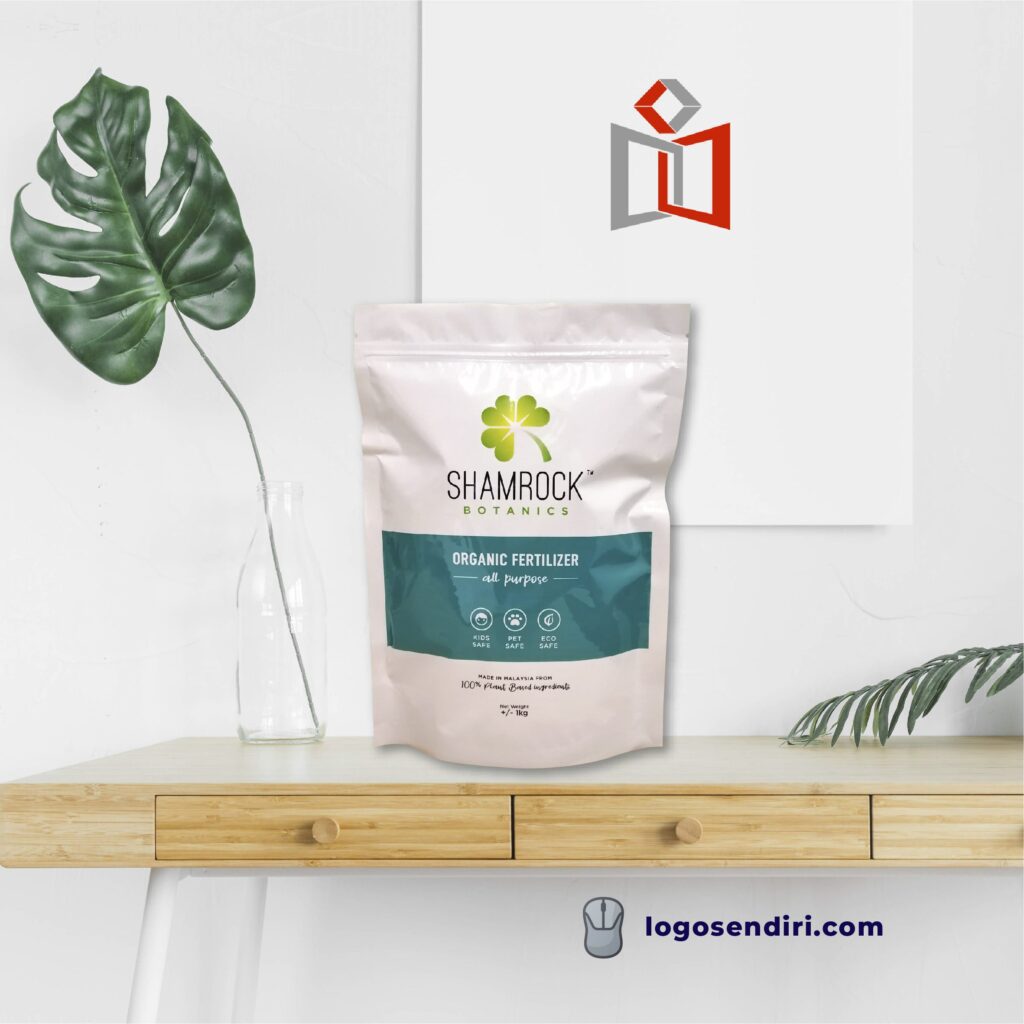
Choosing a fertilizer pouch malaysia format becomes far simpler when you stop asking which bag looks best and start asking where the bag will actually be put to work. A 5kg pack of granules meets a different problem at the filling nozzle, on a godown floor, in the back of a lorry, on a dealer’s counter and in a farmer’s hands.
Each of those moments asks a different question of the film, the seal and the print. The answers do not always point to the same specification. Trace that path before you choose a structure and the format usually follows. Skip it, and you can pay for protection that one stage never uses while leaving the stage that genuinely fails untouched.
Get the order wrong and the consequences are practical rather than theoretical. You approve a stand-up base that creases under a stack, or a glossy finish that scuffs after a dealer has handled the pack a dozen times. Neither problem is visible on a sample lying flat on a desk. This guide follows five touchpoints in the life of a fertilizer pouch malaysia order: fill, warehouse, transport, dealer shelf and farm use. From each one it works backwards to the specification. For every stage I describe the failure that tends to appear there, the format response worth discussing, and the question that should close it before artwork is locked.
Key takeaways
- Start with the touchpoint where the pack is most likely to fail, not with a film name; the same pouch can pass one stage and struggle at another.
- Fill, warehouse, transport, dealer shelf and farm use stress different parts of the pack: seal, base, print and closure each move with the stage.
- Treat any barrier or tolerance figure as a comparison rather than an outcome; confirm behaviour on production-intent samples in your own conditions.
- Bring order volume and artwork timing into the first conversation, since both can decide whether an otherwise sensible format is practical.
- Settle a compact written brief first; that way each supplier quotes against one fixed set of touchpoints instead of their own reading.
Why fertilizer pouch malaysia starts with the lifecycle, not the bag
Ask a converter which pouch suits fertilizer and you will often get a material name in return (a metallised film, a heavier laminate, a cast polypropylene inner layer) as though the material itself decided the outcome. It rarely does. A structure is an answer to a question, and the question belongs to a particular moment in the life of the pack. If you cannot say in one sentence how the product is filled, where it is stored, how it travels, who displays it and how it is used, you cannot judge whether a proposal is clever or merely expensive.
Consider a granulated fertilizer maker who chose a glossy stand-up pouch because it photographed well for an online catalogue. The pack looked excellent on a screen and the first orders went out happily. Then dealers began to report packs that leaned on the counter and printed panels that marked easily once customers picked them up. The first proposal was to specify a heavier barrier film. The real issue was that the format had been chosen for the photograph, not for a heavy product that would be stacked, handled and reopened. Once the brief began with “5kg granules, filled on a bench auger, stacked in a godown, displayed on a dealer counter, opened repeatedly on the farm”, the converter had something concrete to discuss. It could propose a base that carried the weight, a seal area that tolerated dust, and a print surface that survived ordinary handling.
Start with the touchpoint rather than the film and the brief sharpens at once. That order of work does three things for you: you stop paying for a barrier the granules never meet, you test the seal that actually fails, and you give the converter a measurable brief. Our overview of fertilizer packaging sets out the format choices that commonly come up at this stage, but the overview is a menu, not a decision. The decision comes from the journey.
A useful habit is to write the journey sentence at the top of the brief before any format is mentioned: “5kg granules, bench fill, godown storage, courier and lorry movement, dealer display, reopened on the farm.” Use that sentence as a yardstick for every later choice, and drop any element that cannot be traced back to it. A layer, gusset or finish that cannot be tied to one of those stages is decoration, not a specification. This habit also shortens supplier conversations: both sides discuss the same failure instead of trading material names.

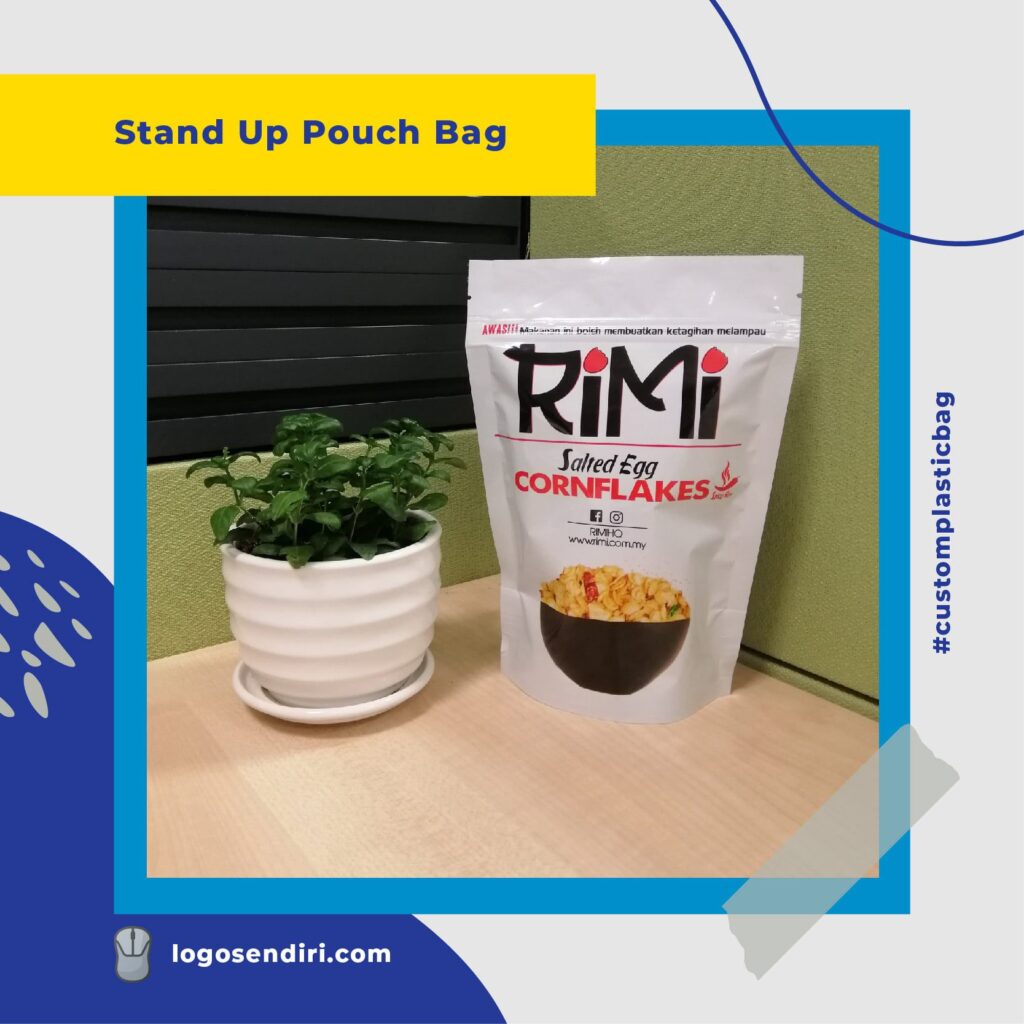
The stand-up pouch shown above puts the point neatly. It has a broad front panel, a resealable top and a printed code, so it clearly answers a merchandising question. What a photograph cannot tell you is how the base behaved once filled, whether the seal tolerated dust from the product, or how the closure coped after being opened many times. Those are touchpoint questions. They are answered by a trial on filled packs, not by admiring the artwork.
Touchpoint 1: the fertilizer pouch malaysia filling line, dust and the seal window
The first contact point is the shortest in time and often the most consequential. Granules, prills and powders behave very differently at the filling nozzle. A free-flowing granule drops cleanly and leaves the seal area tidy; a fine powder throws dust that settles along the inside of the top band. On a fast line, that dust sits exactly where the two film surfaces must meet. A seal that looks perfect on an empty sample can become intermittent once fine material is trapped in the bond, and an intermittent seal is difficult to detect by eye during a production run.
The practical response is not simply a heavier film. Start with the inner sealing layer and ask the converter what it tolerates when product residue is present. A wider seal band gives the dust somewhere to sit outside the bonded area. Dust control at the fill point (a settling period, a gentler drop, a small extraction point) often solves more than a change of laminate would. The gusset matters too: folds in a stiff structure can lift the film away from the sealing jaws, so ask to see the proposed format run on equipment comparable to yours rather than on a hand sample.
Write the fill conditions for your fertilizer pouch malaysia order into the brief in plain language. State the product form, the approximate fill weight, whether filling is by hand, by auger or by a multihead weigher, and the line speed you expect. If you already know that a recipe produces fines, say so at the first conversation instead of waiting for the first trial to reveal it. Any statement about how a structure behaves with dust should be checked on your own product and your own line; treat a supplier’s figure as a starting comparison, then confirm it with a filled run.
It helps to watch the first few packs come off the line and to keep a few aside from the beginning, middle and end of the run. Seal behaviour can drift as the hopper empties or as the film roll warms, and a single sample taken at the start tells you very little. A short, honest record (what held, what shifted, what you changed) is worth more than a long data sheet. If the record shows residue at the seal each time, the answer is usually in the fill method and the seal geometry, not in an extra barrier layer that adds cost without touching the problem.
Touchpoint 2: warehouse storage before dispatch
The second contact point is the one buyers most often overlook, because nothing dramatic appears to happen there. Packs are filled, cartoned and stacked, then left waiting for dispatch. In a warm godown, stacked weight and time together change the shape of a pack and the surface of a print. A base that stood proudly on a desk can slowly bow when five cartons sit above it. A glossy panel can scuff where a corner of the neighbouring carton rubs. Neither is a dramatic failure, yet both arrive at the dealer looking like poor manufacturing.
Independent background on how packaging behaves in storage conditions is published by the Food Packaging Forum, which helps frame the questions before you write any figure into the brief. Use the four columns below to frame questions, not to settle them. Treat the middle columns as prompts for your converter, and use the last column to close each question with a check on your own stock.
| Warehouse condition | Question it raises | Format response to discuss | How to confirm it |
|---|---|---|---|
| Packs stacked several high on a pallet | Does the base keep its shape under the weight above? | Gusset style and base film matched to the filled weight | Stack filled packs for the dwell period you actually use, then inspect the base |
| Warm, humid godown air | Does the film stay flat and the print remain legible? | A film structure agreed with the supplier for your storage conditions | Keep samples in your own godown and compare them with the originals |
| A long dwell before dispatch | Does the seal still look continuous after waiting? | Seal width and inner layer reviewed against the real product | Check seal continuity across a run after the storage period |
| Mixed products in one carton | Do corners rub against neighbouring packs? | Film surface and print position agreed before artwork is final | Inspect packs from the bottom and the top of the carton |
| Repeated handling at the dispatch bench | Does the surface mark where the pack is gripped? | Print placed away from fold and rub zones | Handle a carton the way the warehouse really handles it |
Read the table as a set of trade-offs rather than a list of answers. A stiffer base may resist bowing and still crease at the fold; a print moved away from one rub zone may land in another. Each change should be traced back to the condition you observed, not to a general wish for a stronger pack. If your dominant problem is a bowed base, a change to the print varnish will not rescue it. Name the condition first, then ask the supplier which part of the structure answers it.
Agree a realistic stack height and dwell period with the warehouse before you approve a fertilizer pouch malaysia format. Those two facts are often available and rarely written down. Once they are in the brief, the supplier can propose a base and film that fit the actual conditions instead of a generic best-case scenario. Confirm any tolerance claim with a trial on filled packs; a figure copied from a data sheet is not a result from your godown.
Touchpoint 3: fertilizer pouch malaysia transport abrasion and stack pressure
The third contact point begins when the cartons leave the godown. A fertilizer pouch malaysia order usually travels by lorry, sometimes by courier for smaller packs, and the journey introduces movement that a static stack never sees. Vibration settles the product downwards, so a pack that looked evenly filled at dispatch arrives with its contents packed into the base. Cartons shift against one another, corners rub, and the weight of the upper layers presses on whatever sits below. The pack is expected to absorb all of that without looking damaged when a dealer opens the carton.
The format response worth discussing is usually about surfaces and geometry rather than barrier performance. A film with a forgiving surface can resist the dulling that shows up after repeated rubbing. Generous corner radii reduce the sharp points that concentrate pressure. The way packs are arranged in the carton matters as much as the film: a tight, even pattern distributes weight, while a loose pattern lets packs rock and scuff. Ask your supplier how comparable formats travelled in previous runs, and treat the answer as a prompt for a trial rather than as a settled result.
Weight marking also earns its place at this stage. A pack that clearly states its filled weight is easier for a dealer to sort and for a customer to recognise, and the marking should stay legible after the journey. Position printed information where it will not be rubbed by the carton wall or by a neighbouring corner. If a code or a panel is part of the design, check what it looks like on a pack that has actually travelled, not on a fresh sample held under studio light.
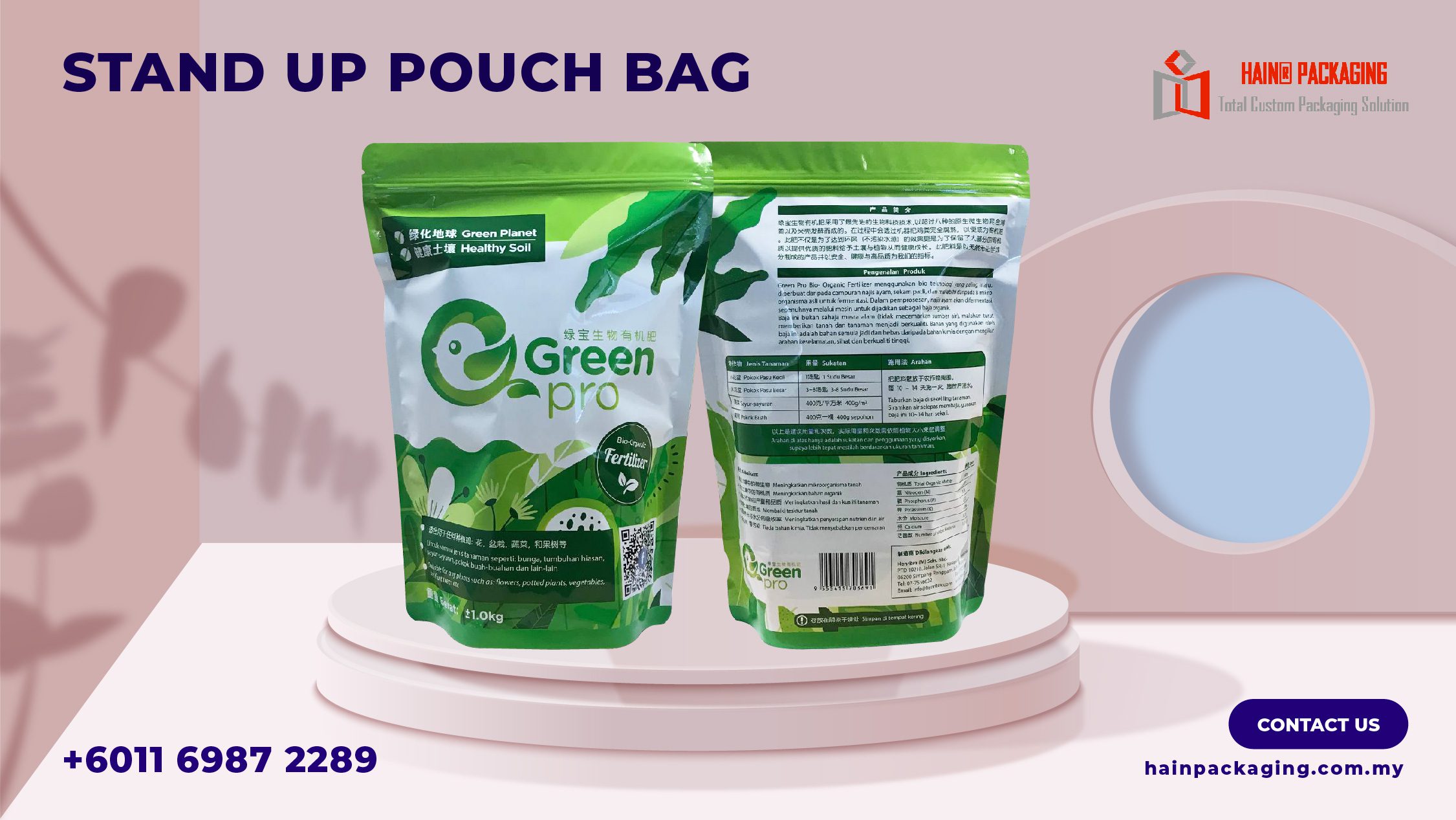
The filled stand up pouch shown above makes the transport point concrete. Weight is not only a fill figure; it is what presses on the base of the pack below during a journey. A styled photograph cannot show how the film surface coped with rubbing in a carton, or whether the printed panel survived being handled at the other end. Those points belong in the brief, and they are confirmed with packs that have made the real trip rather than with a sample that has stayed on a desk.
Touchpoint 4: dealer shelf and standing display
The fourth contact point is where the pack has to sell without help. A dealer gives it a few centimetres of counter or shelf space, often beside competing products, and a customer decides in a moment whether to pick it up. The pack must stand, the front panel must be readable at a glance, and the information a buyer looks for (weight, product type, directions) must be findable without turning the bag over. A format that performed well in the warehouse can still fail here if the base cannot hold the pack upright after a day of handling.
Standing display introduces a specific set of questions. How wide is the base relative to the filled weight? Does the pack lean when the product settles towards one side? Can a customer lift it by the top without the side seams taking more load than they were designed for? Our notes on stand-up pouches in Malaysia describe how format, gusset and print interact once the pack reaches a retail surface, which is a useful visual check before you fix the dimensions.
Print deserves attention at this stage too. A design that reads beautifully on a screen can become crowded when reduced to the width of a dealer shelf, and a matte or glossy finish changes how it reads under shop lighting. Decide early where the weight mark and the product name sit, and keep them clear of the seal and the fold lines. If a code is part of the pack, place it where a customer can reach it with a phone without tilting the bag awkwardly. Small decisions like these decide whether the pack works as a display item or merely as a container.
The dealer is also the first person to handle every pack in a consignment. Ask what happens when a carton is opened and the packs are lined up: do they stand on the first attempt, or does someone need to reshape the base? If reshaping is needed, the problem belongs in the specification, not in the dealer’s routine. A short visit to a counter, or a photograph from the dealer, is often enough to identify the issue before the next order is placed. Confirm any change on filled packs standing in the conditions you actually see, rather than on an empty mock-up.
Touchpoint 5: farm use, reclosure and residue
The fifth contact point is where the pack stops being a retail object and becomes a working container. A farmer opens it with gloves on, often in a shed or beside a field, takes what is needed, and closes it again. Granules find their way into the closure channel. Dust clings to the seal area. The pack may be set down on soil, carried in a vehicle, and reopened many times before it is empty. A closure that felt crisp on a sample can become stiff once residue builds up in its track, and a comfortable opening action on day one is not the same as a comfortable action after repeated use.
This is the stage where buyers most often ask for a resealable top, and the request is reasonable; a fertilizer pouch malaysia pack is seldom emptied in one session. But the closure needs to be chosen for the way it is used, not for the word itself. A simple press-to-close profile may be enough for a coarse granule that rarely leaves residue. A finer product that dusts the track may need a profile with a cleaner channel and a seal area that stays away from the product path. Whatever you choose, test it with the real material. Open and close the pack the number of times you expect in practice, with the same gloves and the same handling you see on site. Any tolerance conclusion should be confirmed by that trial rather than assumed from a sample.
Residue also changes how the pack is regarded after the contents are used. A bag that closes cleanly can be kept for seed, tools or a second product; one whose closure has gummed up is thrown away sooner. That is a practical observation about handling, not a claim about how long anything lasts. Keep the language in the brief equally practical: describe the product form, the likely number of openings, the conditions at the point of use, and the behaviour you want to verify. A supplier can then propose a closure and seal area against a real task.
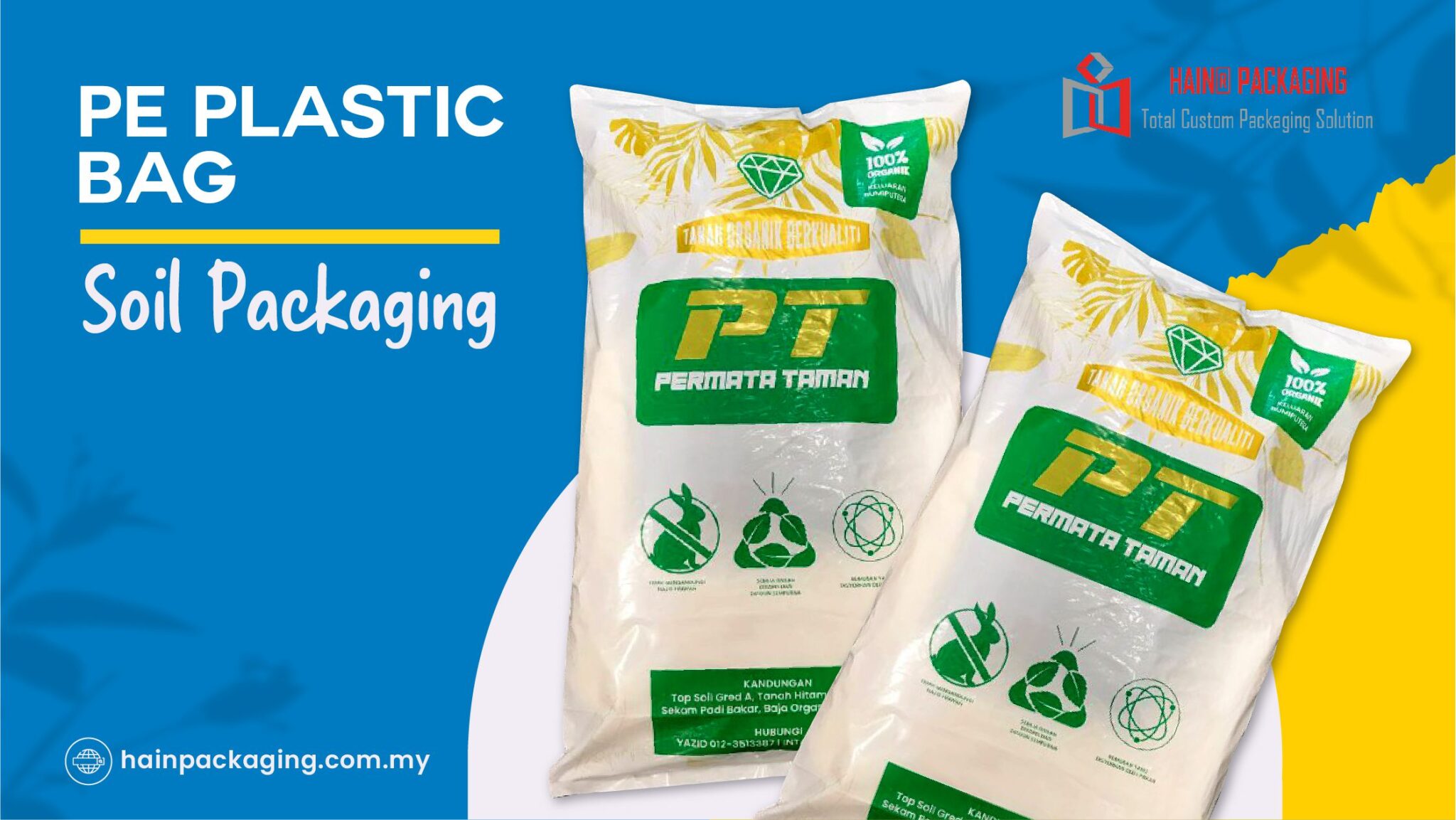
The soil bags shown above carry a glossy surface and a good deal of printed information, which is typical of products that move from a counter into everyday use. A glossy finish can look sharp when new and mark once it is handled on a farm bench. The photograph tells you how the pack was presented; it cannot tell you how the closure felt after the tenth opening or how the seal coped with residue. Those are the questions to take into the trial, because they are the ones a farmer will notice.
Map fertilizer pouch malaysia touchpoints into one specification
Once all five stages are on the table, the specification conversation becomes much shorter. You are no longer asking for the best pouch in the abstract; you are asking which structure, base, print position and closure answer the failure that appears at each stage. The table below turns each touchpoint into a specification item and the question that should close it. It is a working map, not a finished drawing, and it should be read alongside the notes you made during trials.
Fertilizer is only one member of that family. If you also pack feed, chemicals or seed, place this page beside the industrial and agricultural bag range before you fix any structure.
| Touchpoint | Failure that arrives first | Specification item it drives | Question to close it |
|---|---|---|---|
| Fill | Powder sitting in the seal band | Inner sealing layer and seal width | Did the seal hold across the whole production run? |
| Warehouse | Base bowing and print scuff in a stack | Base film, gusset and print position | How did filled packs look after your real dwell period? |
| Transport | Rubbed corners and settled contents | Film surface and carton arrangement | What did the bottom layer look like on arrival? |
| Dealer display | A pack that leans or reads poorly | Base width, front panel and weight mark | Does it stand after a day of handling? |
| Farm use | Residue in the closure channel | Closure profile and seal area | Did the closure survive repeated opening with the real product? |
Notice that the stages are not ranked by sophistication. Farm use is not a simpler version of warehouse storage, and the dealer counter is not a less technical version of the filling line. Each has a failure that arrives first. When a supplier proposes a format, test it against that failure. Check whether the seal tolerates the fines and the base survives the stack. Then ask whether the print stays legible after a journey, whether the pack stands when handled, and whether the closure keeps working with residue present. A fertilizer pouch malaysia brief that keeps those five questions visible will produce comparable quotes, because every converter is answering the same set of problems.
Packaging World reports on developments in flexible formats and converting, which helps you frame a question even though it does not replace a trial on your own pack. Treat a trend as a prompt to ask rather than an instruction to change. The same discipline applies to a fertilizer packaging supplier: give every supplier the same journey sentence and the same trial notes, and the responses become far easier to weigh against one another.
How long an order takes depends on the exact build and the quantity involved, so confirm the timing with sales before you fix any launch date. Surface approval steps and artwork file requirements at the first conversation, before anyone signs a design off, not in a late review round after the file has done the rounds. A delayed launch is usually a planning failure rather than a packaging failure. The touchpoint map is useful precisely because it turns vague worries into items that can be settled early.
Fertilizer pouch malaysia FAQ
Which fertilizer pouch format suits a 5kg pack?
Start from the journey rather than the weight alone. A 5kg pack of coarse granules often works well in a gusseted stand-up format with a straightforward closure, provided the base has been checked with the filled weight and a realistic stack above it. A finer product that dusts at the seal may need a wider seal band and a closer look at the fill method before the format is fixed. Keep the first artwork simple, run a modest trial with the real product at each of the five stages, and let the results decide. A fertilizer pouch malaysia supplier can recommend a starting structure once you share the product form, fill method and how the pack reaches the customer.
Do I need a resealable closure for fertilizer?
Usually yes, because most fertilizer packs are opened more than once, but the reason matters more than the feature. Choose the closure for the way the pack is used: a coarse granule that leaves little residue asks less of the channel than a fine product that dusts into it. Test the action with gloves on and with the real material, opening and closing the pack as many times as you expect in practice. If a simpler closure survives that trial, there is little reason to specify a more elaborate one. Confirm behaviour on your own product rather than assuming that a closure which worked for another line will work for yours.
How does storage humidity change the film choice?
Humidity in a godown can affect how a film lies flat, how a print reads and how a base holds its shape, so it belongs in the brief as a condition to be tested rather than a figure to be copied. Tell the supplier where the packs will be stored, for roughly how long and at what stack height, then keep comparison samples in the same place. Any view on which structure performs better should be confirmed with filled packs in your own storage conditions. Treat the answer as a decision contact point: it helps you choose between options, not as a statement about what the product will do over time.
Conclusion: name the fertilizer pouch malaysia touchpoint first
A sound fertilizer pouch malaysia brief is short, testable and written from the journey outwards. Say how the product is filled, where it waits, how it travels, how it is displayed and how it is used. Name the failure that matters at each stage, choose the simplest format that answers it, then confirm the whole thing with a modest trial on production-intent samples. An enquiry written to this pattern puts suppliers on equal footing, so their quotes can be weighed against one another instead of against their own reading of a vague request.
The five touchpoints in this guide are a working tool, not a set of boxes. A single order may feel two of them much more strongly than the others, and the dominant one can change as volumes grow or as the route to market shifts. Let the touchpoint lead the brief instead of a preferred film, hold every decision in writing, and the specification stays intact from the first sample through repeat orders. The artwork can wait until those decisions are settled; it should never be the reason they were made.
Talk to Logos Sendiri about your fertilizer pouch malaysia specification. If you want an independent read on a draft brief, the Logos Sendiri team can review format, seal, base and closure options against your product, your filling process, your storage conditions and the quantity you plan to order. Tell us which touchpoint worries you most, what has gone wrong up to now and which options you have already tested; we will shape those details into a brief that any converter can price with confidence. Ask us about your fertilizer pouch malaysia specification and start the conversation.