Malaysian F&B Packaging: Bakery, Sauce & Frozen
May 25, 2026
Retort Pouch Malaysia: Sterilisation & Shelf Life
May 25, 2026Die Cut Bag Malaysia: HDPE & Retail Branding Guide
Die Cut Bag Malaysia: HDPE & Retail Branding Guide
From pasar malam stalls to high-end boutiques, die cut bags are the workhorse of Malaysian retail — from pasar malam vendors to department stores, these economical shopping bags carry the nation’s purchases. This guide covers everything you need to know about die cut bags in Malaysia: materials, handle configurations, custom printing, and supplier selection.
Table of Contents
- What Is a Die Cut Bag?
- HDPE vs LDPE for Die Cut Bags
- Handle Types & Load Capacity
- Die Cut Bag Sizing Guide
- Retail Branding & Custom Printing
- Industry Uses in Malaysia
- Eco-Friendly Die Cut Options
- Cost & Pricing Guide
- Quality Control & Testing
- Supplier Selection
- Frequently Asked Questions
1. What Is a Die Cut Bag?
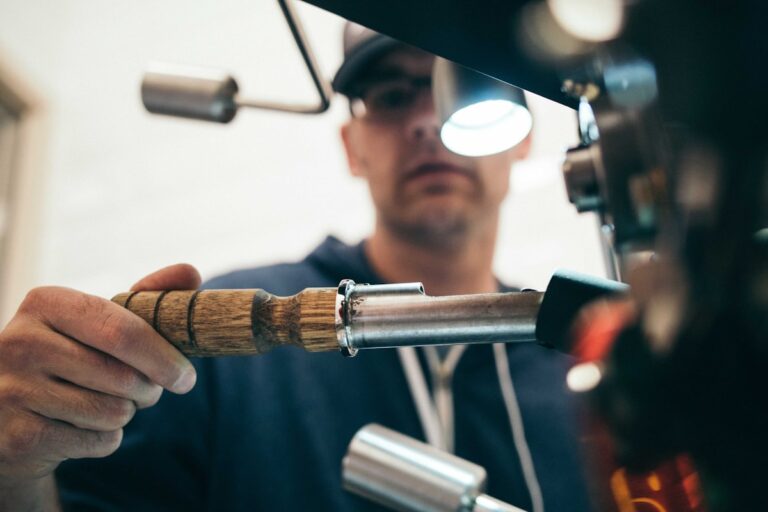
A die cut bag (also called a die cut handle bag or punch handle bag) is manufactured by cutting the handle shape directly into the bag body using a precision die. This creates a clean, consistent handle opening without the need for a separate handle attachment.
1.1 Advantages of Die Cut Bags
- Cost-effective — No separate handle component needed; simplest construction
- Lightweight — Less material per bag compared to patch handle or D-cut bags
- Fast production — Single-step die cutting is faster than handle welding
- Consistent quality — Die cutting ensures uniform handle shape and placement
- Compact storage — Flat-packed, takes minimal warehouse space
1.2 Limitations
- Lower load capacity than patch handle bags (typically 2-5 kg)
- Handle can stretch under heavy loads (especially LDPE)
- Not suitable for very heavy or sharp-edged products
2. HDPE vs LDPE for Die Cut Bags
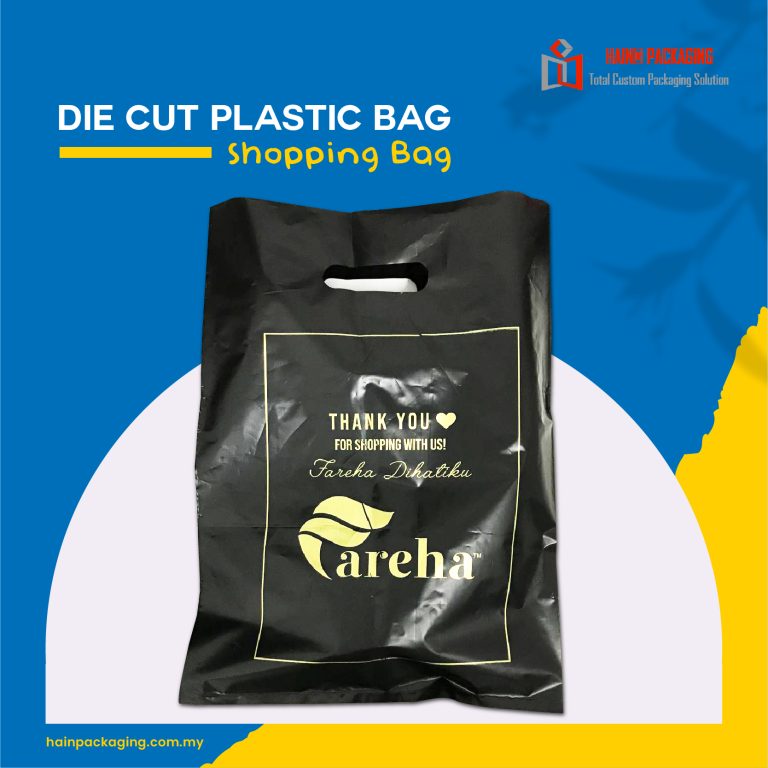
For businesses in Malaysia requiring die cut bag, understanding material grades is essential.
| Property | HDPE | LDPE |
|---|---|---|
| Appearance | Matte, crinkly, semi-transparent | Glossy, smooth, more transparent |
| Stiffness | Rigid, stands upright | Flexible, drapes |
| Strength-to-weight | Excellent (stronger at lower thickness) | Good (needs thicker film for same strength) |
| Typical thickness | 25-50 microns | 40-80 microns |
| Print quality | Good (flexographic) | Very good (smoother surface) |
| Cost | Lower (less material per bag) | Higher (more material per bag) |
| Common use | Supermarket, pasar, food stalls | Boutique, fashion, premium retail |
| Recyclability | Yes (Category 2) | Yes (Category 4) |
2.1 When to Choose HDPE
- High-volume retail (supermarkets, convenience stores)
- Cost-sensitive applications (pasar malam, food stalls)
- Lightweight products (clothing, packaged food, stationery)
- Disposable / single-use shopping bags
2.2 When to Choose LDPE
- Premium retail (fashion boutiques, gift shops)
- Heavier products that need flexibility (shoes, homeware)
- Brands wanting glossy, high-quality print surface
- Reusable shopping bags (thicker gauge)
3. Handle Types & Load Capacity
Malaysian suppliers of die cut bag vary significantly in capability and certifications.
| Handle Type | Description | Load Capacity | Comfort | Best For |
|---|---|---|---|---|
| Standard die cut | Oval cut-out, reinforced edge | 2-5 kg | Basic | General retail, supermarket |
| Reinforced die cut | Handle area folded and welded | 5-8 kg | Good | Department store, heavier items |
| Die cut with loop handle | Cut-out plus attached loop | 8-12 kg | Very good | Premium retail, gift bags |
| Wave-top die cut | Scalloped top with handle cut | 2-4 kg | Good | Boutique, fashion |
| V-cut handle | V-shaped handle opening | 2-4 kg | Good grip | Carry-out food, bakery |
4. Die Cut Bag Sizing Guide
| Size Code | Dimensions (W×H+Gusset) | Typical Use | Volume |
|---|---|---|---|
| S | 10×14+3″ | Small items, pharmacy, stationery | Light |
| M | 12×16+4″ | Clothing, packaged food, gifts | Medium |
| L | 14×18+4″ | Supermarket, department store | Standard |
| XL | 16×20+5″ | Bulky items, homeware, shoes | Large |
| XXL | 18×22+6″ | Bedding, large retail items | Extra large |
5. Retail Branding & Custom Printing
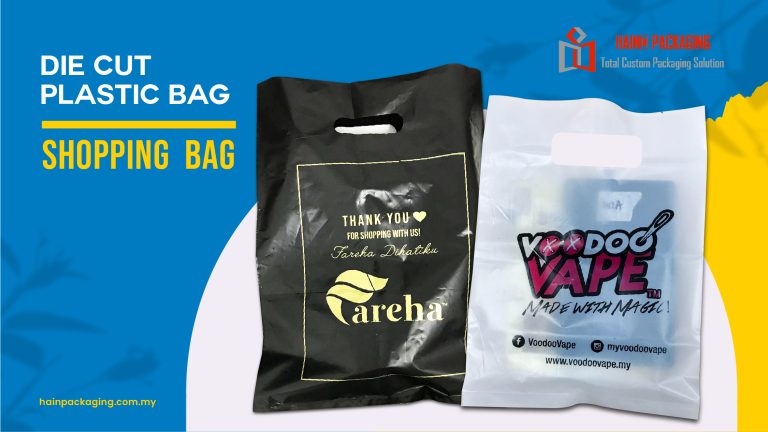
5.1 Printing Methods
| Method | Colours | Quality | MOQ | Setup Cost |
|---|---|---|---|---|
| Flexographic | 1-6 | Good | 5,000+ | RM 200-800 |
| Rotogravure | 1-8 | Excellent | 10,000+ | RM 1,000-3,000 |
| Screen printing | 1-4 | Good | 1,000+ | RM 100-300 |
5.2 Branding Design Tips
- Logo prominence — Centre placement, maximum contrast against bag colour
- Store information — Address, phone, operating hours on bottom panel
- Tagline space — Brand tagline or promotional message on side panel
- QR code — Link to website, WhatsApp, or loyalty programme
- Reuse messaging — “Please reuse this bag” promotes sustainability
6. Industry Uses in Malaysia
| Industry | Common Bag Type | Typical Size | Thickness |
|---|---|---|---|
| Supermarket & grocery | HDPE die cut | L (14×18+4″) | 40μ |
| Fashion & boutique | LDPE die cut (glossy) | M (12×16+4″) | 60μ |
| Pharmacy | HDPE die cut | S-M (10×14+3″) | 35μ |
| Food stalls & pasar | HDPE die cut | M (12×16+4″) | 30μ |
| Convenience store | HDPE die cut | M (12×16+4″) | 35μ |
| Electronics & IT | LDPE die cut (anti-static) | L (14×18+4″) | 60μ |
7. Eco-Friendly Die Cut Options
| Option | Decomposition | Strength | Cost Premium | Recyclable |
|---|---|---|---|---|
| Standard HDPE | 500+ years | ★★★★★ | Baseline | Yes |
| Oxo-degradable HDPE | 2-5 years | ★★★★☆ | +10-20% | No (degraded) |
| Biodegradable (PBAT/PLA) | 6-12 months | ★★★☆☆ | +40-80% | Compostable |
| Paper die cut bag | 2-6 months | ★★★☆☆ | +50-100% | Yes |
| Recycled content HDPE | Same as virgin | ★★★★☆ | +5-15% | Yes |
8. Cost & Pricing Guide
| Bag Type | Size | Thickness | MOQ | Price/pc (RM) |
|---|---|---|---|---|
| Plain HDPE die cut | 12×16+4″ | 35μ | 10,000 | 0.03-0.06 |
| 1-colour printed HDPE | 12×16+4″ | 40μ | 5,000 | 0.06-0.10 |
| Full-colour printed LDPE | 12×16+4″ | 60μ | 5,000 | 0.15-0.25 |
| Premium LDPE (matte) | 14×18+4″ | 70μ | 3,000 | 0.20-0.35 |
| Eco biodegradable | 12×16+4″ | 40μ | 5,000 | 0.10-0.20 |
9. Quality Control & Testing
- Handle tensile test — Measure force to break handle (target: ≥15N for HDPE 40μ)
- Seal strength — Bottom seal must withstand 2× rated load without failure
- Drop test — Bag filled to rated capacity dropped from 1m height; no failure
- Ink adhesion — Tape test (ASTM D3359); no ink transfer
- Dimensional check — ±2mm tolerance on width and height
10. Supplier Selection
10.1 HAIN Packaging Die Cut Solutions
HAIN Packaging offers comprehensive die cut bag manufacturing:
- HDPE and LDPE die cut bags in all standard and custom sizes
- In-house flexographic printing (1-6 colours) and rotogravure (1-8 colours)
- Reinforced handle options for heavier load requirements
- Eco-friendly options: oxo-degradable, biodegradable, recycled content
- Anti-static options for electronics and IT retail
- Competitive MOQ from 5,000 pieces (custom print)
- Nationwide delivery including Sabah and Sarawak
11. Frequently Asked Questions
What is a die cut bag?
A die cut bag is a plastic shopping bag with a handle shape cut directly into the bag body using a die-cutting process. Unlike patch-handle bags (where a separate handle is welded on), die cut handles are part of the bag itself, making them more economical and lightweight.
What material are die cut shopping bags made from?
Die cut shopping bags are typically made from HDPE (high-density polyethylene) for stiffness and strength, or LDPE (low-density polyethylene) for flexibility and premium feel. HDPE is more common in Malaysia due to its cost-effectiveness and stiffness for retail use.
What is the difference between die cut and patch handle bags?
Die cut bags have the handle cut directly from the bag film, making them lighter and cheaper. Patch handle bags have a reinforced separate handle welded onto the bag, providing higher load capacity. Die cut bags suit light retail items; patch handles are for heavier loads.
Can die cut bags carry heavy items?
Standard HDPE die cut bags (40-50 microns) can carry approximately 2-5 kg. For heavier items, use LDPE die cut bags (60-80 microns) or switch to patch handle bags with reinforced handles. Always match bag specification to expected load.
Are die cut bags recyclable in Malaysia?
Yes, HDPE and LDPE die cut bags are recyclable through Malaysia plastic waste collection streams (Category 2 for HDPE, Category 4 for LDPE). HAIN Packaging also offers biodegradable and oxo-degradable options for environmentally conscious brands.
What is the MOQ for custom printed die cut bags?
MOQ for custom-printed die cut bags in Malaysia starts from 5,000-10,000 pieces for flexographic printing. Larger orders (50,000+) benefit from significant per-unit cost reductions. Plain stock bags are available from 1,000 pieces.
12. Die Cut Bag Manufacturing Process
12.1 Production Steps
- Film extrusion — HDPE or LDPE resin extruded into tubular film via blown film process. Typical output: 50-150 kg/hour per line.
- Printing — Flexographic or rotogravure printing on the outer surface. Web speed: 100-200 m/min for flexo.
- Bag making — Film is folded, bottom-sealed, and cut to bag length.
- Die cutting — Precision die cuts the handle shape into the top of each bag. Die tolerances: ±0.5mm.
- Reinforcement (optional) — Handle area folded and heat-welded for reinforced die cut bags.
- Inspection — Visual or machine vision check for print quality, seal integrity, and handle consistency.
- Packing — Bags counted and packed in cartons (typically 500-1,000 bags per carton).
12.2 Die Design Considerations
- Handle shape — Oval (most common), rectangular, or custom shapes. Oval distributes stress better.
- Handle size — Must accommodate typical hand size; minimum 40mm wide × 90mm tall opening.
- Edge distance — Handle must be at least 20mm from top and side edges to prevent tearing.
- Radius corners — All corners rounded (minimum 3mm radius) to prevent stress concentration and tearing.
13. Die Cut Bag Regulations in Malaysia
13.1 Plastic Bag Levy
Malaysia imposes a plastic bag charge (20 sen per bag in Selangor, varying by state) at retail checkout. This affects die cut bag usage: Hain Packaging manufactures custom die cut bags in Malaysia for retail and food applications.
- Charge applies to carrier bags including die cut shopping bags
- Does not apply to packaging bags used as product packaging (e.g., bakery bags, produce bags)
- Some retailers have eliminated free carrier bags entirely, offering reusable alternatives
- Impact: reduced demand for standard die cut carrier bags, increased demand for branded reusable bags
13.2 Single-Use Plastics Roadmap
| Phase | Timeline | Impact on Die Cut Bags |
|---|---|---|
| Voluntary reduction | 2020-2025 | Charge per bag, awareness campaigns |
| Restricted use | 2025-2028 | Only compostable/oxo-degradable allowed at retail |
| Elimination target | 2030 | No conventional plastic carrier bags at retail |
14. Die Cut Bag Alternatives & Innovations
14.1 Paper Shopping Bags
- Material: Kraft paper (80-150 gsm) with twisted or flat paper handle
- Pros: Recyclable, premium appearance, compliant with plastic bans
- Cons: Not moisture-resistant, higher cost (RM 0.30-1.00/bag), heavier
14.2 Non-Woven Bags
- Material: Polypropylene non-woven fabric (80-120 gsm)
- Pros: Reusable (100+ uses), large branding area, strong
- Cons: Higher unit cost (RM 0.50-2.00), not recyclable in standard streams
14.3 Cotton / Canvas Tote Bags
- Material: Cotton or canvas (150-300 gsm)
- Pros: Premium, highly reusable, natural material
- Cons: High cost (RM 2.00-8.00), heavy, long production lead time
15. Future of Retail Bag Packaging in Malaysia
- Transition from HDPE die cut to compostable and paper alternatives by 2030
- Smart bags with NFC or QR codes for loyalty programmes and anti-counterfeiting
- Minimal packaging movements reducing bag usage at checkout
- Loop/reuse systems where customers bring own containers (zero-waste stores)
- Carbon-neutral packaging certifications becoming a market differentiator
16. Die Cut Bag Design Templates & Inspiration
16.1 Popular Design Layouts
- Centre logo — Logo centred on one side, store information on reverse. Most common layout for Malaysian retail.
- Full-wrap design — Continuous design wrapping around both sides. Premium look, requires rotogravure printing.
- Stripe design — Bold horizontal or vertical stripes with logo overlay. Eye-catching, economical printing (2-3 colours).
- Seasonal design — Festive themes for Raya, CNY, Deepavali. Requires annual design updates.
16.2 Colour Psychology for Retail Bags
| Colour | Psychology | Popular Malaysian Industries |
|---|---|---|
| Red | Energy, excitement, urgency | F&B, retail sales, Raya promotions |
| Blue | Trust, reliability, professionalism | Healthcare, corporate, IT |
| Green | Nature, health, halal association | Organic, halal food, eco brands |
| Gold/Yellow | Premium, prosperity, celebration | CNY, premium retail, luxury |
| Black | Sophistication, elegance | Fashion, premium brands |
| White | Clean, modern, simplicity | Minimalist brands, healthcare |
16.3 Print File Specifications
- Colour mode: CMYK + spot Pantone colours
- Resolution: Minimum 300 DPI for photographic images
- Bleed: 5mm on all sides beyond cut line
- File format: PDF/X-1a or AI (Adobe Illustrator)
- Fonts: Outlined (converted to paths) to prevent font substitution
- Colour proof: Wet proof or digital proof required before production
17. Die Cut Bag Order Planning
17.1 Lead Time Guide
| Order Type | Lead Time | Notes |
|---|---|---|
| Plain stock bags | 3-5 days | From existing inventory |
| 1-colour flexo print | 2-3 weeks | Standard production |
| Multi-colour flexo print | 3-4 weeks | Plate making + production |
| Rotogravure print | 5-6 weeks | Cylinder engraving + production |
| Rush order (any type) | 1-2 weeks | +20-30% surcharge |
17.2 Inventory Planning
- Safety stock: 2-4 weeks of average usage
- Reorder point: When stock reaches 4-6 weeks of usage
- Seasonal buffer: Order 3-4 months ahead for festive seasons (Raya, CNY)
- Storage: Cool, dry conditions below 30°C; avoid direct sunlight
18. Die Cut Bag Environmental Impact & Solutions
18.1 Lifecycle Analysis
| Bag Type | Carbon Footprint (kg CO₂/1000 bags) | Water Usage (L/1000 bags) | End of Life |
|---|---|---|---|
| HDPE die cut (40μ) | 12-18 | 5-10 | Recyclable (Category 2) |
| LDPE die cut (60μ) | 20-30 | 8-15 | Recyclable (Category 4) |
| Paper bag (80gsm) | 30-50 | 80-150 | Recyclable + compostable |
| Non-woven PP | 40-60 | 10-20 | Limited recycling |
| Biodegradable (PBAT) | 25-40 | 15-25 | Industrial composting |
18.2 Reducing Environmental Impact
- Reduce thickness — Modern HDPE resins allow 25-30μ bags with equivalent strength to older 40-50μ bags
- Use recycled content — Up to 30% post-consumer recycled HDPE without quality loss
- Offer reuse incentive — Discount for customers bringing own bags (reduces consumption 20-40%)
- Right-size bags — Match bag size to typical purchase volume; reduce material waste
- Take-back programme — Collect used bags for recycling; builds brand loyalty
19. Die Cut Bag vs Alternative Shopping Bag Comparison
| Factor | HDPE Die Cut | Paper Bag | Non-Woven PP | Cotton Tote |
|---|---|---|---|---|
| Unit cost (RM) | 0.03-0.10 | 0.30-1.00 | 0.50-2.00 | 2.00-8.00 |
| Load capacity | 2-5 kg | 3-8 kg | 5-10 kg | 10-20 kg |
| Reuse cycles | 1-3 | 3-5 | 50-100 | 200+ |
| Moisture resistance | Excellent | Poor | Good | Poor |
| Print quality | Good | Very good | Excellent | Excellent |
| Storage volume | Very compact | Bulky | Compact | Bulky |
| Recyclability | Yes (Cat 2) | Yes (paper) | Limited | Natural fibre |
| Carbon per use | High (single-use) | Medium | Low (reusable) | Very low (reusable) |
20. Die Cut Bag Order Specification Sheet
20.1 Complete Specification Template
| Parameter | Specification | Your Requirement |
|---|---|---|
| Material | HDPE / LDPE | ___ |
| Thickness | 25-80 microns | ___ |
| Bag dimensions | W × H + gusset (inches) | ___ |
| Handle type | Standard / reinforced / loop | ___ |
| Handle size | W × H (mm) | ___ |
| Print method | Flexo / gravure / screen | ___ |
| Number of colours | 1-8 | ___ |
| Print position | One side / both sides | ___ |
| Bag colour | Natural / white / custom | ___ |
| Quantity | Per order | ___ |
| Packaging | Per carton (500-1000 pcs) | ___ |
| Delivery location | Address | ___ |
| Required date | DD/MM/YYYY | ___ |
20.2 Sample Request Checklist
Before placing a full order, request samples and verify:
- ✅ Material quality and thickness (measure with micrometer)
- ✅ Handle strength (load test with expected weight)
- ✅ Print quality and colour accuracy (compare to approved proof)
- ✅ Bag dimensions (±2mm tolerance)
- ✅ Bottom seal strength (pull test)
- ✅ Overall appearance and presentation
21. Die Cut Bag vs Competitor Bag Formats
21.1 Comprehensive Comparison
When choosing between shopping bag formats for Malaysian retail, consider the complete picture:
| Factor | Die Cut (HDPE) | Patch Handle | Soft Loop | D-Cut (T-shirt) |
|---|---|---|---|---|
| Cost per unit | RM 0.03-0.10 | RM 0.08-0.20 | RM 0.10-0.30 | RM 0.02-0.06 |
| Load capacity | 2-5 kg | 5-10 kg | 8-15 kg | 3-7 kg |
| Premium look | Moderate | Good | Very good | Basic |
| Production speed | Fast | Medium | Slower | Fastest |
| Typical use | Retail, pharmacy | Department store | Fashion, premium | Supermarket, pasar |
21.2 When to Upgrade from Die Cut
Consider upgrading from die cut bags when:
- Your products regularly exceed 5 kg — switch to patch handle or soft loop
- Customer feedback indicates handles are uncomfortable — upgrade to reinforced or loop handle
- You are positioning as a premium brand — soft loop bags project higher quality
- Repeat-use is a brand value — thicker LDPE or non-woven bags last longer
22. Die Cut Bag Marketing & Brand Building
22.1 Using Bags as a Marketing Channel
Your shopping bag is a walking advertisement. Every customer who carries your bag through a mall, down a street, or on public transport is displaying your brand to hundreds of potential customers. Maximise this opportunity:
- Bold logo placement — Logo should be visible from 3+ metres. Minimum logo size: 15% of bag surface area.
- Brand colours — Consistent use of brand colours builds recognition. Custom bag colours available with MOQ of 10,000+.
- QR code call-to-action — “Scan for 10% off your next purchase” drives repeat traffic and captures customer data.
- Seasonal campaigns — Limited edition bag designs for Raya, Merdeka, and other national events create collectibility and social media sharing.
- Sustainability messaging — “I am a reusable bag” or “Made with 30% recycled content” appeals to environmentally conscious consumers.
22.2 Bag as Customer Experience Touchpoint
The unboxing experience extends to shopping bags. Premium brands invest in:
- Tissue paper wrapping — Product wrapped in branded tissue before placing in bag
- Thank-you card — Small card with personalised message and discount code
- Ribbon or seal — Adds premium feel to the bag presentation
- Premium handles — Soft loop or ribbon handles for luxury retail
22.3 Measuring Bag Marketing ROI
| Metric | How to Measure | Typical Result |
|---|---|---|
| Impressions per bag | Estimated views during customer journey | 200-500 per bag |
| QR scan rate | Unique QR scans per 1,000 bags | 5-30 scans |
| Cost per impression | Bag cost ÷ impressions | RM 0.0001-0.001 |
| Brand recall | Survey after exposure | 15-35% aided recall |
This die cut bag Malaysia guide covers the key selection criteria from material grade to print quality — essential reading for retail brand owners.
Requesting samples from multiple die cut bag Malaysia manufacturers allows side-by-side comparison of handle strength and print fidelity before committing.
This die cut bag Malaysia guide covers material selection, print quality, and supplier comparison for retail brand owners.
Related Articles
- Die Cut Handle Bag Malaysia: Complete Guide
- Custom HDPE Polybag Die Cut Solutions
- Custom Die Cut Handle Bags Malaysia
- Die Cut Plastic Bag Supplier Malaysia
Cross-Cluster Resources
- Spout Pouch Malaysia
- Sachet Packaging Malaysia
- Ziplock Bag Malaysia
- Packaging Supplier Malaysia
- Eco Friendly Packaging Malaysia
About HAIN Packaging
HAIN Packaging manufactures die cut shopping bags for Malaysian retail — from pasar malam to premium boutique. Custom printing, eco-friendly options, nationwide delivery.
📞 WhatsApp: +60 12-345 6789
📧 Email: [email protected]
🌐 Website: logosendiri.com Mordor Intelligence reports strong demand for die cut bag solutions across Southeast Asia’s retail packaging market. Mordor Intelligence reports strong demand for die cut bag solutions in Southeast Asian retail packaging.
For expert guidance on your packaging requirements, contact HAIN Packaging for customised solutions and competitive pricing.