Gusset Pouch Malaysia Buyers Order in These Bands
October 19, 2026
Buyers who start asking about eco packaging Malaysia flexible options usually expect a product list. What they actually need is a decision. There are three routes into more sustainable flexible packaging — recyclable mono-material, compostable, and reduction — and they solve three different problems. Choosing the wrong one does not simply fail the sustainability goal. It can shorten shelf life, break your sealing window on the filling line, or leave you with a claim that a retailer’s auditor will not accept.
This page is about flexible formats only: films, laminates, pouches and roll stock. Rigid trays, bottles and cartons follow different rules and different recycling streams. If you want the wider picture across every format, start with our eco-friendly and recyclable packaging guide — here we stay on film, and on the decision.
Key takeaways
– The three routes are not alternatives to each other. Recyclable, compostable and reduction each have a narrow set of conditions under which they actually hold.
– Mono-material means trading barrier performance away. If your product needs a long ambient shelf life, that trade is the whole conversation.
– Compostable film only makes sense where an industrial composting route exists. In most of Malaysia, post-consumer collection does not reach that route.
– Reduction is the least discussed and the fastest to execute: thinner gauge, fewer layers, no secondary wrap.
– Switching routes changes at least five fields on your spec sheet, not just the material name.
A seasoning manufacturer in Shah Alam came to us last year with a clear brief: “make the pouch eco.” The existing pack was a three-layer laminate with a metallised barrier, and the product ran at ambient for twelve months. The brief had no target — no recycling claim to hit, no composting route, no reduction target. So the first thing we did was not quote a material. We asked three questions, and the answers eliminated two of the three routes before any film was discussed. That sequence is what this article walks through.
Three Routes, and Only One May Fit Your Product
Every conversation about eco packaging Malaysia flexible supply can be reduced to three routes. What matters is not which one sounds best, but which one survives contact with your product, your line and your end market.
| Route | What changes | It holds when | It collapses when |
|---|---|---|---|
| A — Recyclable mono-material | The whole laminate moves to one polymer family (usually all-PE or all-PP) so the pack can enter a film recycling stream | Your product tolerates a lower barrier, and there is a collection stream that takes flexible film | The product needs long ambient shelf life, or no local stream accepts film |
| B — Compostable | Film moves to a certified compostable material, with inks and adhesives that also comply | The pack is collected together with food waste and goes to an industrial composting facility | It ends up in general waste or in a recycling stream, where it becomes a contaminant |
| C — Reduction | Nothing about the material family changes; you use less of it | Any product. This is the fastest route and the easiest to verify | It is treated as the whole answer rather than the first step |
The trap is treating these as a menu. They are not. Route A and Route B are mutually exclusive in practice — a pack cannot be both recyclable-in-film-stream and compostable — and Route C is not a substitute for either, it is what you do while you work out which of the other two is real for you.
Route A is the one most buyers arrive already asking for. You can see how the format works in practice on our recyclable stand up pouch options.
Route A: Recyclable Mono-Material
Mono-material means the entire laminate is built from one polymer family. Instead of a PET outer layer bonded to a PE sealant layer with an aluminium or metallised barrier sandwiched between, you build the structure out of PE with PE, or PP with PP. The pack can then, in principle, be recycled as a single material.
Here is the part that gets skipped in marketing: you pay for that in barrier. Conventional multi-material laminates exist precisely because each layer does a job the others cannot. Remove the PET and the foil and you remove stiffness, heat resistance and part of the oxygen and moisture barrier. For a dry snack with a six-month shelf life, that is usually survivable. For a product that oxidises, or for a pack that must survive a hot fill or a retort cycle, it is not — at least not without a different, more expensive barrier technology sitting inside the mono structure.
Two conditions have to be true before Route A is real:
- Your product can live with the lower barrier. This is a shelf-life question, not a material question. It is answered with accelerated and real-time shelf-life testing, not with a datasheet comparison.
- A stream actually accepts the format. Flexible film is collected and sorted very differently from bottles. Whether kerbside collection in your area takes film, and which polymer families the local sorter wants, decides whether “recyclable” describes a real outcome or just a material property. Malaysia’s separation-at-source programme is administered by SWCorp under the Solid Waste and Public Cleansing Management Act, and SWCorp’s site is where the current scope and accepted categories are published — coverage is not uniform across every state, so check rather than assume.
If both conditions hold, mono-material is the strongest route, because it produces a claim your customer can verify.
Ready to test whether mono-material survives your shelf life? Send us your current spec and target months, and we will tell you what the barrier trade looks like before you commit to artwork.
Route B: Compostable
Compostable film is the route buyers ask for most and the one that most often fails on contact with reality. The material question — can this film break down under industrial composting conditions — is the easy half. The hard half is whether your pack will ever reach those conditions.
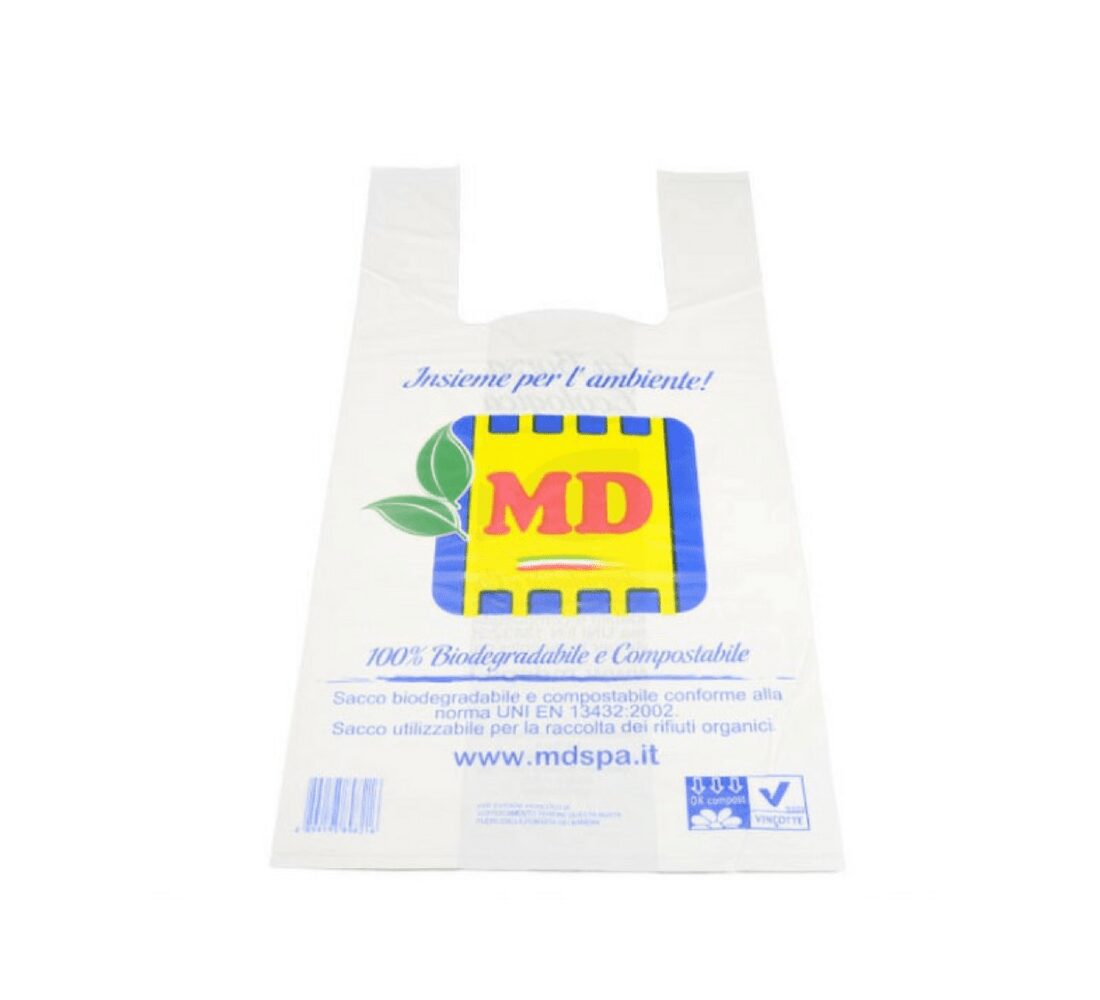
The material side has a real answer. Industrial compostability is defined by standards: the European EN 13432 framework, described in outline by European Bioplastics, and the US ASTM D6400 specification. Certification bodies such as BPI assess against these. Critically, certification covers the whole construction — film, ink, adhesive, coating — not just the base film. A compostable substrate printed with conventional ink is not a compostable pack.
Then comes the part that ends most projects. Compostable packaging is only compostable if it is collected with organics and delivered to an industrial composting facility that accepts it. In much of Malaysia, post-consumer flexible packaging goes to general waste or, if separated, into a plastics stream where a compostable film is a contaminant rather than a benefit. That means the honest test for Route B is not “is this material certified compostable” but:
- Is there a single, closed environment where the pack is used and collected — a stadium, a canteen, a hotel, an in-flight service, an event?
- Does that environment already send its food waste to an industrial composter?
- Will the composter accept packaging, and does your certificate cover the whole construction?
If all three are yes, Route B is legitimate and worth the cost. If any is no, a compostable film is a more expensive way to reach landfill. We keep the distinction between “biodegradable” and “compostable” claims separate on our biodegradable stand up pouch page, because the two words do not cover the same thing and the difference is the one auditors ask about.
Route C: Reduction
Reduction gets the least attention and delivers the most. It asks a boring question: how much film does this pack actually need?

Three levers, in order of how often they work:
- Gauge. Over-specified thickness is the most common waste in flexible packaging. Many packs run thicker than they need because the original specification was set conservatively and never revisited.
- Laminate layers. Dropping a layer — usually the reverse-printed PET or an unnecessary intermediate — removes weight and simplifies the material story at the same time.
- Secondary packaging. Cartons, outer wraps and insert trays are frequently removable. Removing them changes how the retail pack must perform, which is why this lever needs testing rather than assumption.
A frozen food exporter we work with cut total film use per pallet by moving from a heavy three-ply to a lighter two-ply structure and removing the outer printed carton. Nothing about the material family changed, no claim needed rewriting, and the saving showed up in freight as well as in material. That is the character of Route C: unglamorous, verifiable, and available to almost everyone.
Reduction is also the only route that stacks cleanly with the other two. You can reduce first, then move what is left to mono-material. That ordering is what makes most eco packaging Malaysia flexible projects survivable: reduction funds the trial, and the trial is what tells you whether Route A or Route B is real for your product.
What Changes in Your Spec When You Switch
The material name is one line on your spec sheet. Changing route changes at least five more, and these are the fields that cause failed trials:
- Thickness and tolerance. A different structure at the same nominal gauge does not behave the same on the line.
- Seal initiation temperature and sealing window. Mono-material PE structures seal differently from PET/PE laminates. Your existing jaw temperature and dwell are starting points, not answers.
- Ink system and coating. Route B especially: inks and overprint varnishes must comply with the same end-of-life claim as the substrate.
- Coefficient of friction and slip. Changes here affect how the film runs over formers and through the jaws on a vertical form-fill-seal machine.
- Shelf-life validation. Any barrier change re-opens the question. This is the field buyers most often skip and most often regret.
Plan for a trial on your own line, not just a supplier’s data. Lead time and unit pricing depend on specification, print method and order quantity — confirm both with our sales team before you place an order.
How to State the Claim Without Overstating
Three elements make a claim defensible, and all three need to be true at once:
- Say what the pack is — “mono-material PE pouch”, not “eco pouch”. The material is the fact.
- Say what condition it needs — “recyclable where flexible film collection exists”, “industrially compostable”. The condition is what makes the claim honest.
- Say what it does not do — if it is not home-compostable, do not let the artwork imply it is; if it needs a separate collection route, say so on-pack.
The failure mode we see most is a pack that is technically certified and practically misleading, because the artwork says “compostable” in large type and the disposal instruction is nowhere. Regulators and retailers both read that as one problem, not two.
If you are unsure which route your product belongs on, the fastest path is to describe the product, the target shelf life and the market — not to ask for a material. Every eco packaging Malaysia flexible enquiry we handle starts there, because two of the three routes usually eliminate themselves once those three facts are on the table. We will tell you which of the three routes is real for you, and which one to leave alone.
What to Have Ready Before You Switch Route
Two of the three routes eliminate themselves once a handful of facts are on the table. Have these ready and the first call is short:
- Your current structure — the layer build, not just the material name. “PET / metallised PET / PE” tells us more than “metallised laminate”.
- Gauge and tolerance — as specified, and as actually delivered.
- Target shelf life, with the storage condition — twelve months ambient is a different brief from twelve months chilled.
- The failure you are trying to fix — a rejected claim, a retailer requirement, a cost target, or nothing yet.
- Your line’s sealing window — jaw temperature and dwell today. Change the structure and this is the first number that moves.
- The end market and its disposal route — which is what decides whether Route A or Route B is real at all.
Bring those six and we can usually tell you within a day which route survives. Bring one — “we want eco” — and the honest answer is a question back, because the route is decided by the product and its market, not by the material.
Start with your current spec. Send us the structure, gauge, pack format and target shelf life, and we will map it against the three routes before any artwork or tooling is discussed. Lead time and pricing depend on specification, print method and order quantity — our sales team will confirm both against your actual job.