
A Plastic Bag Supplier Kota Bharu Date Is Fixed Before the Quote Arrives
October 11, 2026
A nasi lemak operator in Kajang moved from banana leaf and paper to a sealed pouch and discovered that the sambal had eaten through the seal by the second day. The film was a food grade laminate, the sealer was new, and the crimp photographed perfectly. What had happened is that the pack had been specified for a dry product. It was then filled with something hot, oily and acidic at the same time, and those three conditions attack a laminate in three different ways. Nasi lemak packaging Malaysia projects fail on that combination more than on any single factor. The failure almost always looks like a sealing fault when it is nothing of the kind.
The three conditions are worth separating before anything else, because the fixes are different and two of them pull against each other. Heat softens the sealant layer and reduces the pressure a seal can hold while it is still warm. Oil, specifically the coconut fat in the rice and the chilli oil in the sambal, attacks the adhesive between laminate layers and migrates through the sealant over hours rather than minutes. Acid, from tamarind, lime and fermented ingredients, does its work slowly and mostly at the seal edge. A pack specified against one of the three will pass a bench test and fail on the shelf, which is why the bench test is the wrong test.
Nasi lemak packaging Malaysia specifications are usually written for a dry product and then used for a wet one, which is the whole distance between a pack that holds and a pack that weeps. The formats in question are the flexible ones used for a packed nasi lemak: the stand-up and flat pouches that hold a portion, the retort pouch used where a shelf stable product is the goal, and the laminated bags used for the component parts sold separately. Rigid trays and the paper and leaf wrapping the dish is traditionally served in sit outside it, and so does a frozen ready meal, which is a different temperature problem with a different set of answers.
Why Nasi Lemak Packaging Malaysia Fails on Three Fronts at Once
The reason this dish is harder to pack than it looks is that all three conditions arrive together and none of them can be removed. The rice goes into the pack hot, because packing it cold means packing it after it has cooled, which is a food safety problem and a texture problem in equal measure. The sambal carries free oil by design, because a dry sambal is not the product. The condiments are acidic because that is what makes them taste correct. A specification that solves any one of the three in isolation is a specification for a different dish.
What makes the combination worse is the order in which the three do their damage. Heat is immediate and visible, so it gets diagnosed first and gets blamed for everything. Oil is slow and invisible, so it gets blamed last and is usually the actual cause. Acid is slowest of all and mostly shows up as a seal edge that has gone matte and started to lift, weeks after the pack was filled. A buyer chasing the heat problem will change the sealer settings, see an improvement that lasts a day, and conclude the film is wrong when the film was never the first thing to change.
There is also a mechanical element that sits underneath all three and is worth naming. A packed nasi lemak has weight concentrated at the bottom and liquid distributed through it, which means the pack is under hydrostatic pressure at the base seal from the moment it is filled. Nasi lemak packaging Malaysia failures cluster at the base seal for exactly this reason, and they cluster there whether the pack is a flat pouch or a stand-up one. A seal that holds against air will not necessarily hold against that pressure, particularly while the sealant is still warm and soft. The base seal is where it fails, and it fails at the point where heat and oil have been working on the same few millimetres of film for hours.
Where the Leak Starts, and Why It Is Not the Sealer
Food grade is a statement about what a material may touch, not about what it will survive. A laminate approved for contact with food has been assessed for migration under defined conditions, and those conditions are usually far gentler than a sambal at filling temperature sitting against the sealant for a day. The gap between the two is where most of these failures live, and it is invisible in a specification because the specification is written in terms of approval rather than in terms of exposure.

The specific mechanism is called oil attack, which a surface coating does not address. Free oil migrates into the sealant polymer, plasticises it, and reduces the temperature at which it softens. The seal that was made correctly then loses strength while it sits on the shelf, and it loses strength fastest exactly where the oil has pooled, which is the base of the pack. The result is a pack that sealed perfectly, held for a day, and then opened under its own weight. Nothing about the sealer was wrong and nothing about the operator was wrong.
The way to specify against this is to name the product rather than the approval. Say coconut fat, say chilli oil, say the filling temperature, and ask for a sealant layer chosen for that combination. The Food Packaging Forum publishes accessible material on food contact migration and why the conditions of contact matter as much as the material, and it is worth an hour before a specification is written. Locally, the laminated constructions used for oily food are the starting point rather than the general purpose range.
Why Heat Is the Easiest of the Three to Fix
Heat is the easiest of the three and the one that gets the most attention, which is a bad combination. A hot fill is a known problem with known answers: choose a sealant with a higher softening point, allow the seal to cool under restraint rather than in free air, and do not stack hot packs. Each of those is a process change rather than a material change, and each of them is cheap. Buyers who treat heat as the hard problem spend their budget on film and leave the process untouched, which is the wrong way round.
The part of heat that does need a material answer is the interface between hot fill and the seal jaw. If the jaw is closing on a seal area that contains product, the heat is the least of it, because the product is the thing preventing fusion. A hot, oily, particulate product wets the seal land aggressively and a film of it only a few microns thick is enough to block the seal completely. The answer is a jaw profile and a fill sequence rather than a different laminate, and it is the single most cost effective change available to most nasi lemak operations.
The cooling step is where most of the available saving sits, and it is worth being precise about it because it is usually skipped for a reason that sounds sensible. Cooling the product before it is packed costs time, bench space and a fridge, and it introduces a food safety question that a hot fill avoids. The middle path is to fill hot, seal, and then cool the sealed pack under restraint rather than in a stack, so the seal sets while the pack is supported. That costs a rack and a few minutes, and it removes the heat half of the problem without touching the product at all. A pack cooled in a stack, on the other hand, cools slowly and unevenly, and the packs in the middle of the stack stay warm long enough for the oil to do its work on a softened sealant, which is why a single bad pack in a case is so often one from the middle rather than one from the top.
Why Oil at the Seal Is Not a Coating Problem
A coating on the inside of the pack sounds like the obvious fix and gets requested more than any other. It rarely works, because the coating has to survive the heat of filling, the flexing of the pack in transit, and the mechanical action of a customer opening it, and a coating that survives all three is usually a laminate layer rather than a coating. Where a coating is used, it is applied to the film before conversion, which makes it part of the structure rather than something added to the finished pack.
The second reason the coating instinct misleads is that it addresses the wrong surface. The oil that does the damage is the oil at the seal, not the oil on the panel, and the seal is made by melting the sealant layer to itself. A coating that repels oil on the panel makes that surface harder to wet, which is the opposite of what a seal needs. This is why a pack can look perfect, repel oil beautifully on the front, and fail at every seal, and why the specification has to name the sealant separately from the body of the laminate.
What a Thicker Film Costs You at the Jaw
Thickness is the most requested change and the least useful one. A thicker laminate raises the heat required at the jaw, lengthens the dwell time, and slows the line, and none of those make a better seal. What makes a better seal is the right sealant, at the right temperature, with a clean seal land, held under restraint while it cools. A thinner pack with a correctly specified sealant will outperform a thicker one with a general purpose sealant on every measure that matters, and it will run faster.
There is one place where thickness genuinely helps, and naming it keeps the myth from being overcorrected. Puncture resistance. A pack containing fried anchovies, peanuts or a hard condiment has sharp points that work against the film during transit, and a thicker or tougher outer layer resists that. The correction is to specify the outer layer for puncture and the inner layer for sealing, rather than to thicken the whole structure, and that is a two-line specification rather than a single number.

What a Cold Bench Test Hides From Nasi Lemak Packaging Malaysia Buyers
A cold test tells you almost nothing, because two of the three mechanisms are time and temperature dependent. Fill a pack with cold rice and cold sambal, seal it, squeeze it, and it will pass. Every pack passes that test, and nasi lemak packaging Malaysia buyers who rely on it are the ones who discover the problem from a customer rather than from a bench. The version that predicts the shelf fills at production temperature, holds at ambient for twenty four hours, and is then opened and examined at the base seal rather than at the top. That test takes a day and it is the only one that catches oil attack before a production run does.
The test is cheap and worth describing precisely because the details decide whether it means anything. Fill at the temperature you actually fill at, not at a convenient one. Seal with the settings you actually use, not with the settings that produce the prettiest crimp. Store the filled packs upright, because that is how they will be stored, and because upright is what puts the oil against the base seal. Then open the base seal and look for a matte, softened band rather than for a leak, because the softened band appears days before the leak does.
What Steam Does to a Seal That Held on Day One
Steam is the condition buyers forget, because it is not in the product specification and it does not appear until the pack is closed. Hot rice in a sealed pack gives off water vapour, that vapour condenses on the coldest surface it can find, and the coldest surface is the inside of the pack. The result is a pack that fogs, a product that looks unappealing through the film, and a headspace that alternates between positive and negative pressure as the pack warms and cools through the day.
The mechanical consequence is worse than the cosmetic one. Pressure cycling works the seal, and a seal that holds a constant load will not necessarily hold a load that reverses several times a day. Where a pack is filled hot and sold cold, either allow the pack to cool before it is sealed, or specify a seal that is tested under cycling rather than under a static pull. The heat sealable food bag range is built around the sealant behaviour rather than around the panel, which is the distinction this section is about.
The Print Specification for a Pack That Travels Warm
Print on a hot, oily pack is a functional layer and not a decoration. Ink sits on the surface that is handled, and a pack that is filled hot and transported in a warm vehicle is a hostile environment for ink adhesion. Scuffing, blocking and transfer onto an adjacent pack are all more likely at elevated temperature, and a print that survives a desk will not necessarily survive a delivery van. Ask for the rub resistance to be tested at temperature rather than at ambient, and say so when the artwork is commissioned.
The second functional role of print is the information panel. A packed meal sold through a retailer carries weight, ingredient and handling information that has to stay legible for the life of the pack, and legibility on a flexible pack is a print specification rather than a design one. Where the pack is likely to be stored in a warm place, ask for the ink system to be chosen for that condition. Where the product travels, the Malaysian Quarantine and Inspection Services sets out the inspection requirements that apply to food moving through checkpoints, and a pack that cannot be identified at a checkpoint is a pack that gets held.
One Question to Settle Before You Trust Your Own Bench
Five questions have to be answered in writing before the plates are made. Is the sealant layer named for coconut fat and chilli oil at your filling temperature, or only for food contact in general? Will the seal land actually be clean at the moment the jaw closes, and does the pack cool under restraint? Is the outer layer specified for puncture against the particular particulates in your product, such as fried anchovies or peanuts, rather than for thickness in general? Has the twenty four hour upright test been run at production temperature with production settings and examined at the base seal? And has the ink system been tested for rub resistance at the temperature the pack travels at rather than at room temperature?
A vague answer to any one of them is the field to push on while it is still cheap to change, and the whole set is worth asking before the artwork is commissioned rather than after.
The commercial side of this is worth one sentence, because it decides how much of the above is worth doing. The rush option is quoted at 5-7 weeks and the standard order at 10–12 weeks, so a specification that has to be reopened after artwork approval does not fit inside either window. Nasi lemak packaging Malaysia orders that specify the sealant first and the artwork second never collide, and the ones built the other way round collide reliably. Ask for a hot-fill sample pack and test it at your own filling temperature, which is the only test that predicts your shelf.
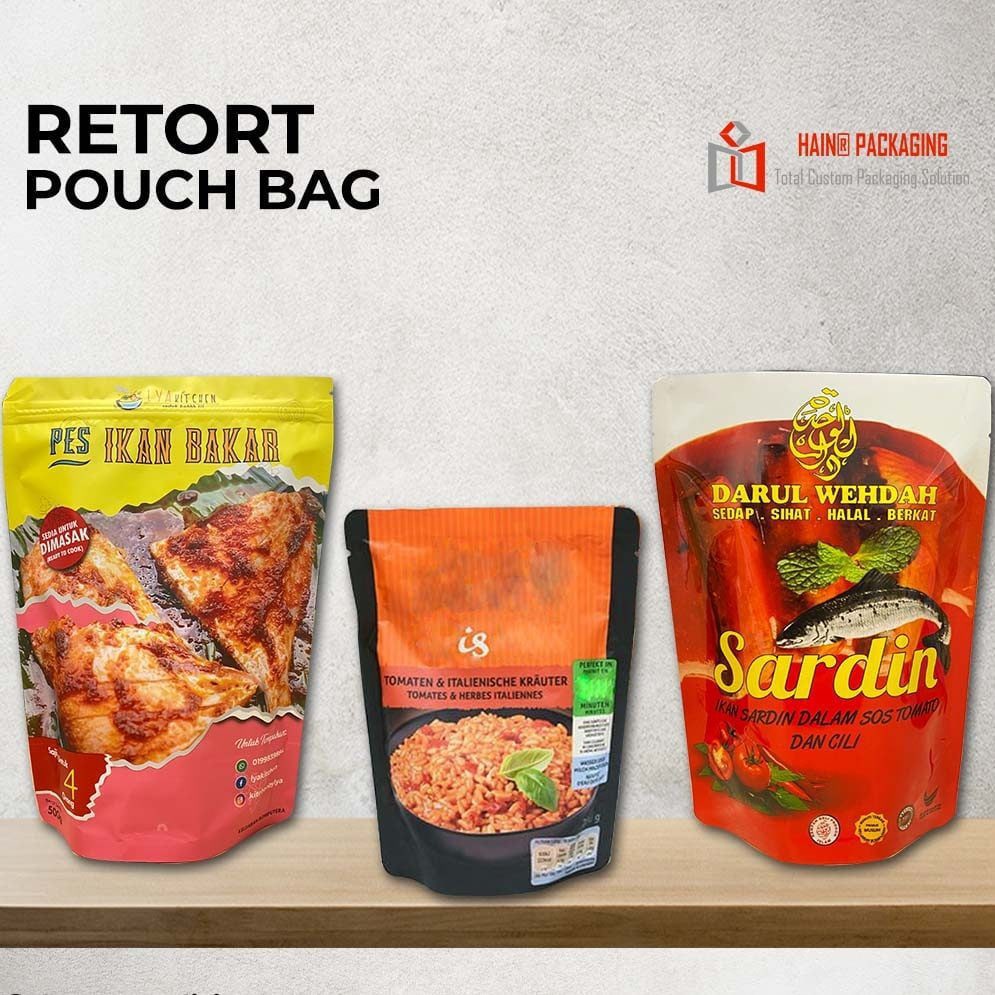
Where the product is sold as components rather than as a portion, the same three conditions apply to a different object, and the sambal and paste packs, the retort pouch formats and the general food pouch range cover most of what that looks like. Where it is sold as a hot portion over the counter, the answer is usually a material choice made on the sealant rather than on the format, and the wider food packaging notes are the place to start if the three conditions above are new to you.
Fill one nasi lemak packaging Malaysia pack at your own filling temperature, stand it upright for a day, then cut the base seal open and look for a matte band. If the band is there, the sealant is wrong and no setting on the machine will save it.