
Pharmacy Bags Malaysia: Complete Medical Packaging Guide
May 25, 2026Aluminium Foil Pouch Malaysia: Materials & Applications
May 25, 2026Tamper Evident Pharmacy Bags Malaysia: Security Guide
Tamper Evident & Medical Packaging Malaysia: Security, Sterile & Cold Chain Solutions
Tamper Evident Pharmacy Bags Malaysia: Security Guide
When it comes to pharmaceutical packaging, security is non-negotiable. as Malaysia’s pharmaceutical and healthcare sectors grow, the demand for specialised medical packaging — tamper evident security bags, sterile barrier systems, and cold chain packaging — has become mission-critical. Regulatory pressure from NPRA, MDA, and international GDP standards means that choosing the right medical packaging is no longer optional; it is a compliance requirement. Tamper evident pharmacy bags Malaysia provide verifiable evidence of security breaches, making them essential for controlled substances, high-value medications, and e-pharmacy delivery applications.
This guide provides a deep dive into the three most critical medical packaging segments in Malaysia: tamper evident and security bags, sterile medical device packaging, and cold chain pharmaceutical packaging. Whether you manage a hospital pharmacy, pharmaceutical distribution centre, or e-pharmacy, this guide covers the specifications, regulations, and supplier options you need.
Table of Contents
- Tamper Evident & Security Bags for Pharmaceuticals
- Anatomy of Security Features
- Packaging for Controlled Substances
- Sterile Medical Device Packaging
- Cold Chain Pharmaceutical Packaging
- E-Pharmacy & Home Delivery Packaging
- Hospital Dispensary Packaging Workflows
- NPRA GDP Packaging Compliance
- Packaging Validation & Testing
- Cost Comparison by Packaging Type
- Supplier Qualification Checklist
- Frequently Asked Questions
1. Tamper Evident & Security Bags for Pharmaceuticals
For businesses in Malaysia requiring tamper evident pharmacy bags, understanding material grades is essential.
1.1 Why Tamper Evident Packaging Matters in Malaysia
Malaysia’s pharmaceutical supply chain faces unique challenges: tropical climate, distributed geography (Peninsular + Sabah/Sarawak), a growing e-pharmacy sector, and increasingly strict NPRA oversight. Tamper evident packaging addresses these challenges by providing:
- Patient safety assurance — Visual confirmation that medication has not been accessed since dispensing
- Regulatory compliance — NPRA GDP guidelines mandate tamper evident packaging for controlled substances
- Chain-of-custody documentation — Sequential numbering enables audit trails from dispensing to patient receipt
- Brand protection — Custom security features deter counterfeiting
- Legal protection — Documented tamper evidence supports dispute resolution and insurance claims
1.2 Types of Tamper Evident Bags
| Type | Security Level | Key Features | Typical Use Case |
|---|---|---|---|
| Void-seal bags | Medium | VOID pattern on peel, adhesive closure | Community pharmacy dispensing |
| Security slit bags | Medium-High | Tear-to-open strip, non-resealable | Prescription delivery, clinic dispensing |
| Heat-sealed numbered bags | High | Sequential numbering, heat seal, receipt tear-off | Controlled drugs, hospital pharmacy |
| Multi-layer co-extruded | Very High | Void layer, security print, tamper-proof closure | Narcotics, clinical trials, high-value items |
| Evidence-grade bags | Maximum | Barcoded, witnessed closure, chain-of-custody form | Forensic, law enforcement, regulatory inspection |
1.3 Sizing and Thickness for Pharmaceutical Use
| Application | Recommended Size | Thickness | Monthly Volume (Est.) |
|---|---|---|---|
| Single prescription (1-3 items) | 6×9″ (152×229mm) | 60 microns | Per pharmacy: 2,000-4,000 |
| Multiple prescriptions | 8×10″ (203×254mm) | 70 microns | Per pharmacy: 500-1,000 |
| Controlled substance transport | 6×9″ or 8×10″ | 80 microns | Per hospital: 200-500 |
| Inter-facility transfer | 9×12″ (229×305mm) | 80-100 microns | Per distributor: 1,000-3,000 |
| Clinical trial samples | Custom | 80-100 microns | Variable |
2. Anatomy of Security Features
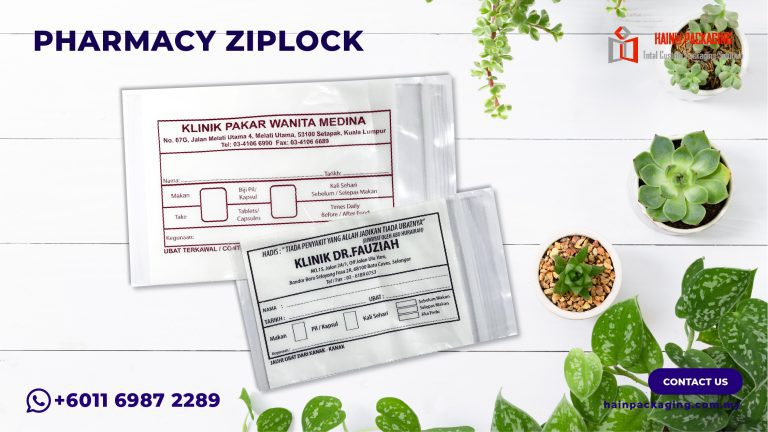
Malaysian suppliers of tamper evident pharmacy bags vary significantly in capability and certifications.
2.1 Void Pattern Technology
Void pattern technology is the most widely used tamper evident mechanism in Malaysian pharmaceutical packaging. Here is how it works:
- Construction — A co-extruded film with a special release layer between the outer surface and the adhesive
- Activation — When the adhesive flap is sealed (peel-and-seal or heat-seal), the bond forms between the adhesive and the bag body
- Evidence — Peeling the seal separates the release layer, transferring a “VOID” or custom pattern to both the flap and the bag surface permanently
- Irreversibility — The pattern cannot be resealed or hidden; any attempt to re-glue or re-heat will be visually obvious
2.2 Sequential Numbering Systems
Sequential numbering provides documented chain-of-custody tracking:
- Format — Typically alphanumeric (e.g., TE-2026-00001)
- Placement — Printed on both the bag body and the tear-off receipt
- Duplicate system — Receipt portion detaches for the dispensing record while the number remains on the bag
- Barcode option — Some manufacturers offer barcode printing for scanning into pharmacy management systems
- Audit trail — Numbers can be recorded at dispensing, transit, and receipt points
2.3 Security Slit Design
The security slit is a pre-scored opening line designed to be the only way to open the bag:
- Positioned on one side of the bag, clearly marked “TEAR HERE TO OPEN”
- Once torn, the bag cannot be resealed — the tear is permanent and obvious
- The slit is designed to be easy enough for patients to open but impossible to reseal
- Some designs include a secondary seal strip for re-closure after opening (for multi-dose medications)
2.4 Anti-Counterfeiting Features
For high-security applications, additional anti-counterfeiting features can be incorporated:
| Feature | Security Level | Verification Method | Cost Impact |
|---|---|---|---|
| UV-fluorescent ink | Medium | UV lamp inspection | +10-15% |
| Microtext printing | High | Magnification (10x+) | +15-20% |
| Holographic stripe | Very High | Visual tilt inspection | +25-40% |
| Thermochromic ink | Medium | Temperature change (finger heat) | +15-25% |
| Watermark pattern | High | Backlight inspection | +20-30% |
| Custom security artwork | Very High | Multi-point verification | +30-50% |
3. Packaging for Controlled Substances
3.1 Malaysian Drug Schedule Classification
Under the Poison Act 1952 and Dangerous Drugs Act 1952, controlled substances in Malaysia are classified into schedules that determine packaging requirements:
| Schedule | Examples | Tamper Evident Required | Additional Requirements |
|---|---|---|---|
| Schedule 1 (Dangerous Drugs) | Morphine, Fentanyl, Methadone | Mandatory (high-security) | Dual-witness sealing, double-counting |
| Schedule 2 | Cocaine, Pethidine, Oxycodone | Mandatory (high-security) | Witnessed dispensing, register entry |
| Schedule 3 | Codeine combinations, Dihydrocodeine | Recommended | Prescription record keeping |
| Schedule 4 | Benzodiazepines, Anabolic steroids | Recommended | Prescription record keeping |
| Schedule 5 (Exempted) | Certain OTC preparations | Optional | Standard dispensing |
3.2 Packaging SOPs for Controlled Substances
Hospitals and pharmacies dispensing Schedule 1-2 drugs must implement these packaging SOPs:
- Pre-dispensing verification — Confirm prescription validity and patient identity
- Dual-witness packaging — Two authorised staff members present during packaging
- Sealed tamper evident bag — Medication placed in sequentially numbered bag, sealed in presence of both witnesses
- Documentation — Bag number recorded in dangerous drugs register with both witnesses’ signatures
- Handover — Patient or courier signs receipt acknowledging tamper evident bag number
- Discrepancy procedure — Any seal breach triggers incident report, stock count, and NPRA notification if warranted
3.3 Transport Security for Controlled Substances
When transporting controlled substances between facilities:
- Use heat-sealed tamper evident bags with sequential numbering
- Document bag numbers on transfer paperwork (delivery order + dangerous drugs register)
- Use lockable transport containers for high-risk items
- GPS-tracked vehicles for inter-city transfers
- Courier must sign chain-of-custody documentation at each handover point
4. Sterile Medical Device Packaging
4.1 Regulatory Framework
Medical device packaging in Malaysia is regulated separately from pharmaceutical packaging:
- MDA (Medical Device Authority) — Registration and classification under Medical Device Act 2012
- ISO 11607-1 & -2 — Packaging for terminally sterilised medical devices
- EN 868 series — Materials for sterilisation packaging
- ISO 13485 — Quality management for medical devices
4.2 Sterile Barrier System Requirements
A sterile barrier system (SBS) must maintain sterility until the point of use. Key requirements:
- Microbial barrier — Prevent bacterial penetration for the declared shelf life
- Seal integrity — Validated seal strength (typically 1.5-3.0 N/15mm peel force)
- Sterilisation compatibility — Must withstand the chosen sterilisation method without degradation
- Aseptic opening — Allow presentation of contents without contamination
- Shelf life validation — Accelerated and real-time aging studies to prove barrier performance over time
4.3 Sterilisation Method Compatibility
| Sterilisation Method | Compatible Materials | Max Temp | Typical Applications |
|---|---|---|---|
| Ethylene Oxide (EtO) | Tyvek, PET/PE, Paper/Film | 50-60°C | Heat-sensitive devices, electronics |
| Gamma Radiation | HDPE, PP, PET, Tyvek | Ambient | Single-use devices, bulk sterilisation |
| Steam Autoclave | Paper, SMS nonwoven, Tyvek | 121-134°C | Surgical instruments, metal devices |
| E-Beam | Most plastics (check dose) | Ambient | Low-density devices, surface sterilisation |
| Hydrogen Peroxide Plasma | Tyvek, select films | 50°C | Heat-sensitive, moisture-sensitive devices |
4.4 Common Sterile Packaging Formats
- Paper-film pouches — Medical-grade paper on one side, transparent film on the other; most common format for surgical instruments and single-use devices
- Tyvek pouches — DuPont Tyvek for superior microbial barrier with breathability; preferred for EtO and radiation sterilisation
- Header bags — Large-format with Tyvek header for steam sterilisation; used for surgical kits and instrument sets
- Rigid sterilisation containers — Reusable aluminium or polymer containers with filter systems for heavy instrument sets
- Form-fill-seal (FFS) pouches — Machine-formed pouches for high-volume production of packaged devices
5. Cold Chain Pharmaceutical Packaging
5.1 Why Cold Chain Packaging Is Critical
Approximately 25-30% of pharmaceutical products in Malaysia require temperature-controlled storage and transport. The World Health Organization (WHO) estimates that 50% of vaccines are wasted globally due to temperature excursions — many caused by inadequate packaging.
5.2 Temperature Range Classifications
| Classification | Temperature Range | Common Products | Packaging Solution |
|---|---|---|---|
| Deep frozen | -70°C to -20°C | mRNA vaccines, some biologics | Dry ice shippers, VIP containers |
| Frozen | -20°C to -25°C | Some vaccines, enzyme preparations | Gel pack + insulated containers |
| Refrigerated | 2°C to 8°C | Insulin, most vaccines, biologics | Insulated bags with gel packs |
| Controlled room temp | 15°C to 25°C | Most oral medications | Insulated packaging for transit |
| Ambient | up to 30°C | Stable medications | Standard packaging with monitoring |
5.3 Cold Chain Packaging Components
- Insulated container — Expanded polystyrene (EPS), polyurethane (PU), or vacuum insulated panels (VIPs)
- Coolant — Gel packs (2-8°C), phase change materials (PCMs), or dry ice (frozen/deep frozen)
- Temperature indicator — Chemical indicators, electronic data loggers, or time-temperature indicators (TTIs)
- Conditioning — Gel packs must be pre-conditioned (refrigerated or frozen) before packing
- Documentation — Packing slip with temperature requirements, logger serial number, and handling instructions
5.4 Malaysian Climate Challenges
Malaysia’s tropical climate (average 27°C, 80%+ humidity) creates specific cold chain challenges:
- Short excursion tolerance — Products may exceed 8°C within minutes if packaging is opened in hot conditions
- Motorcycle delivery — Most e-pharmacy deliveries in Malaysia use motorcycles, exposing packages to direct sunlight and heat
- Last-mile complexity — High-rise apartments, gated communities, and rural areas all present different delivery scenarios
- Seasonal monsoons — Heavy rain during monsoon seasons (Nov-Mar) increases transit times and moisture exposure
5.5 Best Practices for Malaysian Cold Chain Packaging
- Use minimum 25mm EPS or equivalent insulation for 2-8°C products
- Pre-condition gel packs at 2-8°C (not frozen) for refrigerated shipments to avoid freezing damage
- Include a minimum of 2 temperature indicators per shipment
- Calculate transit time + 4-hour safety buffer for insulation sizing
- Test packaging performance at 35°C ambient (worst-case Malaysian scenario)
- Train delivery staff on proper handling — never leave cold chain packages in direct sunlight or hot vehicles
6. E-Pharmacy & Home Delivery Packaging
6.1 The E-Pharmacy Boom in Malaysia
Malaysia’s e-pharmacy sector has grown 35% annually since 2020, driven by COVID-19, digital health platforms, and consumer convenience expectations. Key platforms include DoctorOnCall, AlteCare, and pharmacy chains’ own delivery services.
6.2 E-Pharmacy Packaging Requirements
| Requirement | Standard Delivery | Cold Chain Delivery |
|---|---|---|
| Primary bag | Tamper evident prescription bag | Insulated tamper evident bag |
| Outer packaging | Corrugated mailer or courier bag | Styrofoam/insulated box |
| Temperature control | Not required | Gel packs (2-8°C) or PCM |
| Documentation | Prescription label, patient info | Temperature logger + prescription |
| Branding | Custom-printed pharmacy bag | Branded insulated packaging |
| Delivery time target | Same day / next day | Same day (within 4 hours preferred) |
6.3 Motorcycle Delivery Packaging
Most Malaysian e-pharmacy deliveries use motorcycle couriers (Grab, Ninja Van, in-house riders). Packaging must account for:
- Vibration — Motorcycle roads create significant vibration; packaging must resist seal failure
- Rain exposure — Waterproof outer layer essential for monsoon season
- Heat exposure — Storage in motorcycle top box can reach 50°C+; tamper evident seals must withstand this
- Crush protection — Semi-rigid outer packaging prevents bag damage in transit bags
7. Hospital Dispensary Packaging Workflows
7.1 Inpatient Dispensary Workflow
- Physician orders medication via EMR (Electronic Medical Record)
- Pharmacist verifies order and prepares medication
- Medication placed in ward-specific colour-coded bag
- Tamper evident seal applied (numbered for controlled substances)
- Pneumatic tube or porter delivery to ward
- Ward nurse receives, verifies seal integrity, and signs receipt
- Any seal breach reported to pharmacy for investigation
7.2 Outpatient / Discharge Workflow
- Discharge prescription generated by attending physician
- Pharmacy prepares multiple prescriptions per patient (often 5-10 items)
- Medications packaged in appropriately sized prescription bag
- Bag sealed with tamper evident closure or adhesive strip
- Patient receives bag at discharge counter or via hospital delivery
- Patient information leaflet and storage instructions included
7.3 Ward-Specific Colour Coding
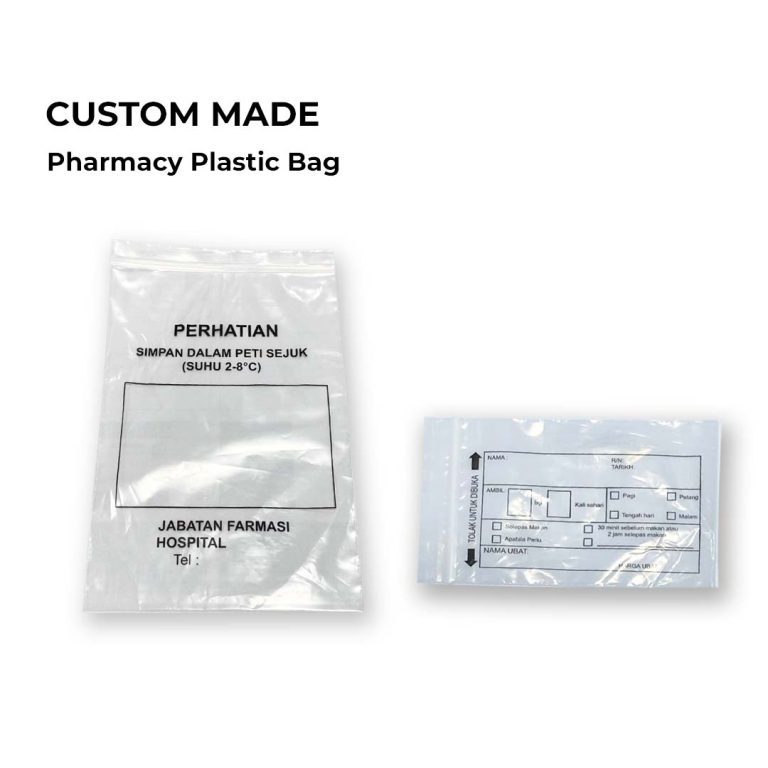
Many Malaysian hospitals use colour-coded bags for different wards to prevent cross-delivery errors: Hain Packaging provides tamper evident pharmacy bags manufactured in Malaysia with full regulatory compliance documentation.
| Ward | Bag Colour | Rationale |
|---|---|---|
| ICU / Critical Care | Red | Urgent, high-risk medications |
| Paediatrics | Yellow | Paediatric dosing, extra caution |
| Maternity / OB-GYN | Pink | Special handling for maternal medications |
| Oncology | Purple | Cytotoxic handling requirements |
| General Wards | Blue / White | Standard dispensing |
| Outpatient | White / Custom branded | Patient-facing presentation |
8. NPRA GDP Packaging Compliance
8.1 Good Distribution Practice (GDP) Overview
The NPRA GDP guidelines (aligned with WHO Technical Report Series No. 957) require pharmaceutical distributors and pharmacies to maintain product integrity throughout the supply chain. Key packaging-related requirements include:
- Qualified packaging — All packaging materials must be sourced from qualified suppliers with documented quality systems
- Temperature mapping — Storage and transport conditions must be validated, including packaging performance at ambient extremes
- Documentation — Complete records of packaging materials, batch numbers, and supplier certificates
- Staff training — All personnel handling pharmaceutical packaging must be trained on GDP requirements
- Deviation management — Any packaging failure or temperature excursion must be documented, investigated, and corrected
- Change control — Changes to packaging materials or suppliers require documented qualification before implementation
8.2 NPRA Audit Checklist for Packaging
| Audit Item | Evidence Required | Common Gap |
|---|---|---|
| Supplier qualification | ISO cert, COA, MSDS, audit report | Missing supplier audit |
| Material traceability | Batch records, delivery notes | Incomplete batch tracking |
| Temperature validation | Mapping study, packaging qualification | No packaging thermal test |
| Tamper evident policy | SOP, training records, incident log | Policy exists but not trained |
| Controlled substance packaging | Dual-witness log, register entries | Missing witness signatures |
| Cold chain documentation | Logger records, excursion reports | No excursion investigation |
| Staff training records | Training matrix, competency evidence | Training not documented |
| Change control records | Change request, qualification, approval | Changes made without approval |
9. Packaging Validation & Testing
9.1 Test Methods for Pharmaceutical Bags
| Test | Standard | Purpose | Acceptance Criteria |
|---|---|---|---|
| Seal strength | ASTM F88 | Verify seal can be opened cleanly | 1.5-3.0 N/15mm |
| Burst strength | ASTM F2054 | Internal pressure resistance | No failure at rated pressure |
| Dye penetration | ASTM F1929 | Detect seal channel leaks | No dye penetration through seal |
| Microbial barrier | ISO 11607-1 Annex B | Verify sterile barrier | Log reduction ≥ 4 |
| Accelerated aging | ASTM F1980 | Shelf life prediction | Barrier maintained post-aging |
| Drop test | ISTA 3A | Transit damage resistance | No seal failure after drop |
| Vibration test | ISTA 3A | Motorcycle/transit vibration | Seal integrity maintained |
| Temperature cycling | Custom (2°C to 40°C) | Malaysian climate simulation | Seal intact, no material degradation |
9.2 Tamper Evident Validation Protocol
- Visual inspection baseline — Document bag appearance before any intervention
- Attempted tampering scenarios — Heat (hair dryer), cold (freezer), chemical (solvent), mechanical (prying)
- Evidence assessment — After each attempt, check for visible evidence (VOID pattern, seal distortion, colour change)
- Functional test — Confirm legitimate opening method works as designed (tear strip, peel tab)
- Report — Document all results with photographic evidence
10. Cost Comparison by Packaging Type
10.1 Pharmaceutical Packaging Cost Matrix (2026 Estimates)
| Packaging Type | Unit Cost (RM) | MOQ | Setup Cost | Lead Time |
|---|---|---|---|---|
| Plain LDPE prescription bag | 0.05-0.10 | 10,000 | Negligible | 1-2 weeks |
| 1-colour printed Rx bag | 0.12-0.20 | 5,000 | RM 200-500 | 2-3 weeks |
| Full-colour Rx bag | 0.20-0.35 | 5,000 | RM 500-1,500 | 2-3 weeks |
| Void-seal tamper evident | 0.30-0.50 | 2,000 | RM 300-800 | 3-4 weeks |
| Numbered security bag | 0.50-0.80 | 2,000 | RM 500-1,200 | 3-4 weeks |
| Multi-layer tamper proof | 0.80-2.00 | 2,000 | RM 800-2,000 | 4-5 weeks |
| Sterile paper-film pouch | 0.50-1.50 | 1,000 | RM 1,000+ | 4-6 weeks |
| Insulated cold chain pack | 3.00-8.00 | 500 | Negligible | 1-2 weeks |
| VIP cold chain container | 15.00-40.00 | 100 | Negligible | 2-3 weeks |
10.2 Total Cost of Ownership
When budgeting for pharmaceutical packaging, consider the total cost beyond the bag price:
- Storage cost — Large MOQ orders require warehouse space (estimated RM 0.01-0.03/bag/month)
- Waste cost — Unused bags due to design changes or regulatory updates
- Training cost — Staff training on new packaging SOPs (RM 500-2,000 per session)
- Validation cost — Packaging qualification testing (RM 2,000-10,000 per product)
- Compliance cost — NPRA audit preparation and documentation (ongoing)
11. Supplier Qualification Checklist
11.1 Mandatory Qualification Criteria
| # | Criterion | Evidence Required | Priority |
|---|---|---|---|
| 1 | SSM Registration | Business registration certificate | 🔴 Mandatory |
| 2 | ISO 9001 certification | Current certificate, scope includes packaging | 🔴 Mandatory |
| 3 | ISO 13485 (if medical) | Current certificate for medical device packaging | 🟡 Required for sterile |
| 4 | Material traceability | COA and MSDS for all materials | 🔴 Mandatory |
| 5 | Food-contact compliance | SIRIM or EU food-contact certification | 🔴 Mandatory |
| 6 | Printing quality | Sample prints, colour consistency records | 🟡 Important |
| 7 | Production capacity | Monthly output, lead time commitments | 🟡 Important |
| 8 | Delivery capability | Coverage area, shipping partners | 🟡 Important |
| 9 | Financial stability | Latest audited accounts | 🟢 Good to have |
| 10 | NPRA audit history | Previous audit findings, corrective actions | 🟢 Good to have |
11.2 HAIN Packaging Qualifications
HAIN Packaging meets all mandatory supplier qualification criteria for pharmaceutical and medical packaging in Malaysia:
- SSM-registered Malaysian manufacturer with full production facility
- ISO 9001 certified quality management system
- Complete material traceability with COA and MSDS for all film grades
- In-house flexographic and rotogravure printing with quality control
- Experience supplying NPRA-audited pharmaceutical clients
- Nationwide delivery including East Malaysia
- Custom tamper evident packaging with void patterns, sequential numbering, and security features
- Sample production and approval process before bulk manufacturing
12. Frequently Asked Questions
What is a tamper evident security bag?
A tamper evident security bag is a specially designed packaging bag that shows irreversible visible evidence if someone has attempted to open or tamper with it. Features include void patterns, security seals, sequential numbering, and tamper-evident closures. In Malaysia, these are used for pharmaceutical dispensing, controlled drug transport, and hospital cash handling.
How do I verify a tamper evident bag is intact?
Check three indicators: (1) the security seal should be fully intact with no lifting or peeling, (2) the sequential number should match your dispensing record, and (3) the void pattern layer should show no ‘VOID’ text or pattern disruption. Any sign of tampering means the bag should be rejected and documented per your SOP.
What packaging is required for cold chain pharmaceuticals in Malaysia?
Cold chain pharmaceuticals in Malaysia require insulated packaging with temperature indicators. This includes insulated bags with gel packs for 2-8°C products, VIP (vacuum insulated panels) for extended transit, and temperature data loggers for WHO-compliant shipments. The NPRA GDP guidelines mandate documented temperature control throughout the supply chain.
Can I use standard plastic bags for medical device packaging?
No. Medical device packaging must comply with ISO 11607 and the Medical Device Authority (MDA) regulations in Malaysia. Standard plastic bags do not meet sterile barrier requirements, biocompatibility standards, or sterilisation validation criteria. Use purpose-made medical device pouches with validated sterilisation compatibility.
What is the difference between sterile and non-sterile medical packaging?
Sterile medical packaging maintains sterility of the device until point of use, requiring validated sterile barrier systems (ISO 11607) and sterilisation compatibility (EtO, gamma, steam). Non-sterile packaging is used for devices that are sterilised at the point of use or do not require sterility. Both must meet MDA classification requirements in Malaysia.
How should e-pharmacy orders be packaged for delivery?
E-pharmacy orders should use tamper evident bags to guarantee integrity during transit, weather-resistant materials for motorcycle delivery (common in Malaysia), branded packaging for patient trust, and clear labelling with patient name and pharmacy details. Temperature-sensitive items require insulated packaging with cool packs.
What are NPRA GDP packaging requirements?
NPRA Good Distribution Practice (GDP) requires that pharmaceutical packaging maintains product integrity throughout the supply chain. This includes validated packaging materials, temperature monitoring for cold chain products, tamper evident features for controlled substances, documented handling procedures, and staff training on packaging protocols.
Where to order tamper evident pharmacy bags in Malaysia?
HAIN Packaging manufactures custom tamper evident pharmacy bags in Malaysia with features including void patterns, sequential numbering, security slits, and heat-sealed closures. Available in various sizes with custom printing. Contact via WhatsApp or their website for quotes with MOQ starting from 2,000 pieces.
When selecting tamper evident pharmacy bags Malaysia suppliers, always request samples and verify GDP compliance documentation before bulk ordering.
When selecting tamper evident pharmacy bags Malaysia suppliers, always verify GDP compliance documentation before bulk ordering.
For e-pharmacy delivery and hospital dispensary use in Malaysia, tamper evident pharmacy bags Malaysia provide the tamper evidence and chain-of-custody documentation required under NPRA GDP guidelines.
Related Articles
Explore more pharmaceutical and medical packaging solutions:
- Custom Printed Prescription Bags Malaysia
- Custom Pharmacy Bags with Logo
- Premium Medical Pharmacy Bags Supplier Malaysia
- Clear Pharmacy Bags Malaysia
- Tamper Proof Plastic Bag
- Tamper Evident Bag Supplier
- Custom Plastic Bag for Medicine Malaysia
- Pharmacy Bags Malaysia: Complete Medical Packaging Guide
Cross-Cluster Resources
- Ziplock Bag Malaysia — resealable pharmaceutical storage
- Sachet Packaging Malaysia — small-dose medication packaging
- Frozen Food Packaging — cold chain packaging parallels
- Retort Pouch Malaysia — heat-stable barrier packaging
- Flexible Packaging MOQ & Pricing — cost planning
About HAIN Packaging
HAIN Packaging is a leading custom packaging manufacturer based in Malaysia, specialising in flexible packaging solutions for pharmaceutical, medical, food, and industrial applications. With expertise in tamper evident technology, sterile barrier systems, and cold chain packaging, HAIN delivers compliant, high-quality packaging solutions to healthcare businesses across Malaysia. The Ministry of Health Malaysia sets stringent requirements for pharmaceutical packaging to ensure consumer safety and product integrity. According to the Ministry of Health Malaysia, pharmaceutical packaging must meet stringent regulatory standards.
📞 WhatsApp: +60 12-345 6789
📧 Email: [email protected]
🌐 Website: logosendiri.com
For expert guidance on your packaging requirements, contact HAIN Packaging for customised solutions and competitive pricing. There is more on this in Industrial, Agricultural & Specialty Bags Malaysia: Pouches for Feed.